How it calculates
The calculator uses one formula:
Runtime (hours) = Rated capacity (Wh) × Efficiency ÷ Total load (W)
- Rated capacity comes from the maker's spec for the station you pick, or the number you type.
- Efficiency is the share of rated capacity that reaches AC appliances after inverter and battery losses. The default range of 80% to 90% is our assumption, not a maker's figure, and you can change it.
- Total load is the sum of the average watts of everything you add, times how many of each.
The low end of the result uses 80% and the high end uses 90%.
Checks it runs for a chosen station
- Continuous output: it adds the running watts of everything on the list and compares the total with the station's continuous AC rating.
- Start-up surge: for appliances with a motor or compressor, it compares their start-up watts with the station's stated surge rating. If the maker states no surge rating, it uses the continuous rating instead.
- Voltage: it flags appliances that need 240 V when the station supplies 120 V only.
Worked examples
All three use the default 80% to 90% efficiency.
| Station capacity | Load | Low estimate | High estimate |
|---|---|---|---|
| 1,000 Wh | 100 W | 1,000 × 0.80 ÷ 100 = 8 h | 1,000 × 0.90 ÷ 100 = 9 h |
| 2,000 Wh | 200 W | 2,000 × 0.80 ÷ 200 = 8 h | 2,000 × 0.90 ÷ 200 = 9 h |
| 1,024 Wh | 60 W | 1,024 × 0.80 ÷ 60 = 13.7 h | 1,024 × 0.90 ÷ 60 = 15.4 h |
What it does not account for
- The station's own idle draw when its screen, fans or Wi-Fi are on.
- Room temperature. Each maker sets operating and charging temperature limits in its manual.
- Appliances whose draw changes a lot with settings, such as a CPAP with a heated humidifier.
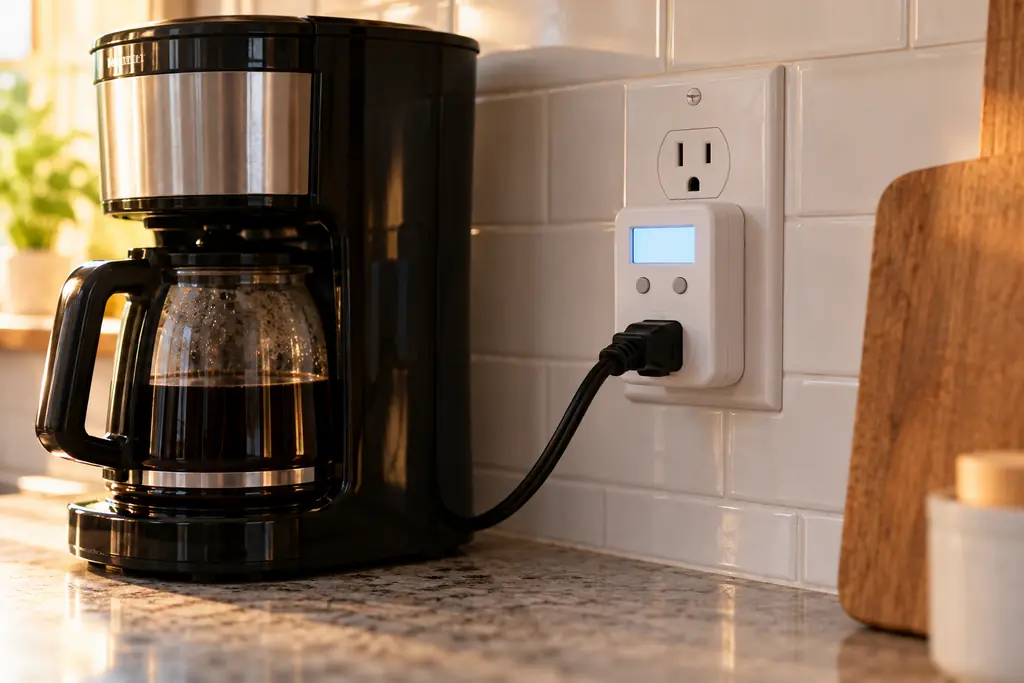
For an appliance you rely on, measure its draw with a plug-in power meter and enter that number instead of a list value.
Questions readers ask
Why is the result a range and not one number?
Inverter and battery losses vary by model and by load, and we don't have a measured efficiency for every model. So we show the result at 80 percent and at 90 percent of rated capacity. You can change both in Assumptions.
Which watts should I enter for a fridge?
Its average draw over a day, not the compressor's running watts. A fridge cycles on and off, so its average is much lower than its running draw. Picking the refrigerator from the list fills in our average.
What does the start-up warning mean?
Motors and compressors draw extra power for a moment when they start. If that draw is above the station's stated surge rating, the station may shut off instead of starting the appliance. Check the appliance's label or manual.
Does running several appliances at once change the runtime?
Yes. The calculator adds their watts together, so the runtime drops, and it warns when their combined running watts exceed the station's continuous rating.