What plug-in solar does
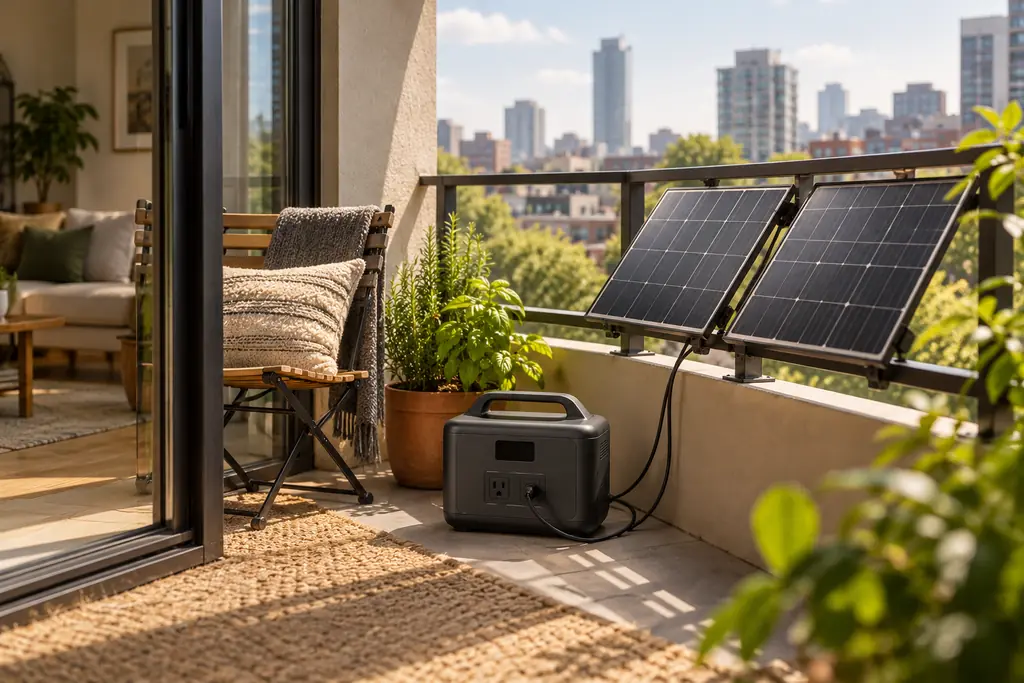
Plug-in solar generates electricity from photovoltaic panels and feeds it into a building's electrical system through a compatible receptacle. It's sometimes called balcony solar because the panels may be meant for smaller spaces rather than a permanent rooftop installation. Its basic job is to offset the electricity you use onsite while utility power is available.
That makes it different from a conventional portable power station. A plug-in solar device supplies electricity to the building through an approved connection, while a power station stores energy in a battery so compatible appliances can use it later. The difference decides which one fits your goal: lower everyday use, or power during an outage.
How plug-in solar differs from battery backup
| Feature | Plug-in solar | Portable power station |
|---|---|---|
| Main purpose | Offset onsite electricity consumption | Store energy for later use |
| Energy source | Photovoltaic panels | Rechargeable battery |
| Connection | Compatible building receptacle, where state law or the utility permits it | Built-in appliance outlets |
| During an outage | Not a backup source; California, for example, requires certified isolation that prevents grid backfeeding | Can supply compatible appliances from stored energy |
| Energy storage | Not part of a basic plug-in PV device | Battery storage is the main component |
"Solar generator" usually means a portable power station paired with compatible solar panels. Those panels recharge the battery; they don't make the setup a receptacle-connected plug-in solar system, so the two terms aren't interchangeable. If your main concern is keeping appliances running during a blackout, start with our portable power station guide.
Why certified isolation matters
Any device that generates electricity into a building has to work safely with that building's electrical system, and the key question is what happens when utility power fails. California's portable solar law makes this a condition: a qualifying device needs a certified isolation feature that separates it from the building's electrical system to prevent grid backfeeding, and it must also meet the law's other certification conditions. Colorado, Vermont and Virginia require a feature that stops the device from energizing the grid or the building, or exporting power, during an outage, and Maine requires inverters set to shut off 0.2 seconds after power is disrupted.
Never use a plug-in solar device that lacks certified outage isolation. Don't assume an ordinary solar panel, portable inverter or power station can safely supply electricity through a household receptacle. Use only equipment specifically designed and certified for the connection you intend.
Plug-in solar is not an outage backup plan
A plug-in solar device that isolates during an outage can't be counted on for household electricity while the grid is down. A charged power station is different: it runs compatible appliances directly through its own outlets. If your household needs power for refrigeration, communications, lighting or medical equipment during an outage, plan a separate backup system.
A portable battery's capacity and output decide what it can support. Our power station finder lets you pick the essential appliances and how long they need to run, then estimates the stored energy required. Don't connect a portable battery to household wiring without listed transfer equipment installed by a licensed electrician with any required permit.
Where plug-in solar has a state law
There is no national plug-in solar rule. As of October 19, 2026, we confirmed enacted laws in the six states below by reading each bill or chapter on the state legislature's own website. Each state sets its own size cap and certification rule, so one state's conditions don't carry over to another.
| State | Bill | Signed | Effective | Size cap | Certification rule | Checked |
|---|---|---|---|---|---|---|
| Maine | LD 1730 (Public Law 2025, chapter 644) | April 6, 2026 | July 29, 2026 | 1,200W export per service address; above 420W needs a licensed electrician | Listed or certified to UL 3700 or a comparable standard from a nationally recognized testing laboratory (NRTL), or configured to the NEC as adopted in Maine | October 19, 2026 |
| Virginia | HB 395 (Chapter 1052) | April 22, 2026 | January 1, 2027 | 1,200W per dwelling unit | Certified by an NRTL and meets the most recent NEC; 391W or less is exempt from listing rules that would require wiring changes | October 19, 2026 |
| Colorado | HB26-1007 | May 7, 2026 | August 12, 2026 | 1,920W, one system per address | Labeled and listed by an NRTL; from January 1, 2027, devices over 391W can't be sold, leased or rented unless UL labeled and listed | October 19, 2026 |
| Maryland | HB 1532 (Chapter 353) | May 12, 2026 | July 1, 2026 | 1,200W, one system per electric meter, residential use | Certified by UL or an equivalent NRTL; 391W or less is exempt from listing rules that would require wiring changes | October 19, 2026 |
| Vermont | S.202 (Act 149) | June 16, 2026 | July 1, 2026 | 1,200W combined inverter capacity per meter | UL 3700 or an equivalent NRTL certification, installed and operated to IEEE 1547-2018 | October 19, 2026 |
| California | SB 868 (Chapter 985) | September 30, 2026 | January 1, 2027 | 1,200W AC per dwelling | Certified as a plug-in PV system by UL or an equivalent NRTL, with a certified outage isolation feature; must meet the most recent NEC and California Electrical Code | October 19, 2026 |
Some conditions don't fit in a table:
- Maine allows up to 420W per service address without an electrician. Between 420W and 1,200W, each system needs a licensed electrician and a dedicated circuit with a single outlet, and the customer must notify the utility within 30 days.
- Maryland requires notifying the electric company before installation and giving it a certification of the system's safety features and maximum generating capacity.
- Vermont allows plug-in devices only on systems that use smart meters.
- California's utility exemption ends January 1, 2030. Our California plug-in solar guide covers the six conditions and the dates.
New York's legislature passed a plug-in solar bill (A9111C, same as S8512C) on May 28, 2026, but on October 19, 2026 the New York Senate's site didn't show it as signed. News outlets report laws in other states, including Utah, Connecticut, New Hampshire and New Jersey, that we haven't yet confirmed on those legislatures' own sites, so they aren't in the table. If your state isn't listed, check its legislature and your utility before buying.
In a state without a plug-in solar law, a device that feeds a building's wiring generally falls under the utility's interconnection rules, so read those rules before you buy anything.
What renters should check
Plug-in solar appeals to renters because they don't own the building or control permanent electrical installations. Before choosing equipment, check:
- Whether your state permits the intended system
- Whether the equipment has the required certification
- Whether your lease allows the proposed arrangement
- Whether landlord permission is required
- Whether building or HOA rules apply
- Whether the intended location is suitable under the manufacturer's instructions
- Whether any utility notice is required
A utility interconnection exemption doesn't, by itself, settle lease terms, property permissions or building requirements. A product marketed as renter-friendly isn't automatically approved for every rental property.
Before buying plug-in solar
Start with what you want the equipment to do. To offset electricity while the grid is up, look at the plug-in solar requirements in your state. To have electricity during an outage, compare compatible battery backup systems instead. For a plug-in device, verify its intended electrical connection, certification, outage isolation and manufacturer instructions, and never use uncertified equipment or improvise a connection to household wiring.
This guide provides general information, not legal or electrical advice. Check current state and local requirements and consult a qualified professional where needed.
Questions readers ask
What is plug-in solar?
Plug-in solar is photovoltaic equipment designed to supply electricity to a building through a compatible receptacle. It is intended to offset electricity consumed onsite.
Is balcony solar the same as a solar generator?
No. Balcony solar generally refers to a plug-in photovoltaic arrangement. A solar generator combines a power station with compatible solar panels and stores electricity in a battery for later use.
Which states have a plug-in solar law?
As of October 19, 2026, we confirmed enacted laws on the state legislature's own website for California, Colorado, Maine, Maryland, Vermont and Virginia. Other states have laws reported in the news that we have not yet confirmed, so check your own state's legislature or utility before buying.
Will plug-in solar power my home during an outage?
Don't count on it. California's law, for example, requires a qualifying device to have certified isolation that prevents grid backfeeding during an outage. A separate compatible battery backup system is needed for stored outage power.
Can renters install plug-in solar?
Renters should check applicable state requirements, their lease, landlord permissions, HOA or building rules, and equipment certification before purchasing or using a system.
Sources
- LD 1730, Public Law 2025, chapter 644 (chaptered law text), Maine Legislature
- General effective date for nonemergency laws of the 132nd Legislature, Second Regular Session, Maine Legislature
- HB 395 (2026), Acts of Assembly Chapter 1052, Virginia Legislative Information System
- HB26-1007, Improve Customer Use Distributed Energy Resources (bill status and signed act), Colorado General Assembly
- HB 1532, Chapter 353 of 2026 (chapter text), Maryland General Assembly
- Act 149 of 2026 (S.202), as enacted, Vermont General Assembly
- SB-868 Electricity, portable solar generation devices (Chapter 985, Statutes of 2026), California Legislative Information
- Assembly Bill A9111C (2025-2026 session), bill status, New York State Senate