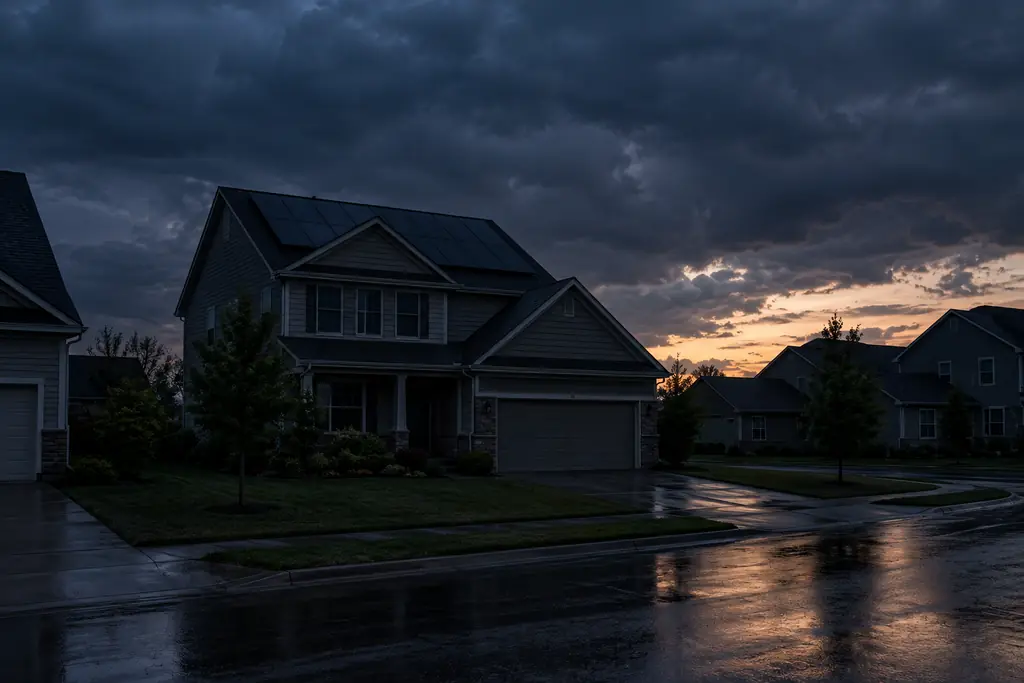
Why most grid-connected systems shut down
The Department of Energy puts it plainly in its solar resilience guide: home solar systems depend on the grid to produce power, and for safety they are designed to switch off when grid power cuts out. That happens on a clear afternoon as readily as at dusk. The panels keep collecting light, and the inverter that turns their output into household power stops.
The reason sits in the inverter. DOE's guide to inverters says household inverters ride through small, brief dips in voltage or frequency, and disconnect and shut down when a disturbance is long or large. Most of them are "grid-following": they take their timing signal from the grid, so when the grid goes, so does the signal they follow. DOE's summary is that residential panels alone are not enough to make a home resilient.
What anti-islanding protects
An "island" is a section of the network that stays energized after the utility supply has failed. A rooftop system feeding power into a dead street line would create one, and an NREL and Sandia primer on the rule (2022) names the hazard: utility workers, or anyone else nearby, who don't know the line is live.
IEEE 1547-2018 is the US interconnection standard for distributed energy resources such as rooftop solar. The primer says anti-islanding protection is required for all equipment that complies with IEEE 1547-2018 and UL 1741, the main US certification for interconnection equipment. If a system forms an unintentional island, it must detect it, stop energizing and trip within 2 seconds. When the grid comes back, the default delay before the system returns to service is 5 minutes. So a short blink in the grid can leave your solar offline for several minutes after the lights return.
When a system can keep supplying power
A few systems give some power in an outage without any battery, under tight limits. SMA's Sunny Boy US-41 inverters have a feature called secure power supply operation. During a grid failure in daylight, it feeds one dedicated outlet from the panels. It can't work at night. SMA's manual says the power on that outlet swings with the weather and may not be available at all, so it shouldn't feed anything that needs a stable supply. After an overload, or when the sun drops too low, it tries again after 20 seconds.
SMA's current hybrid inverter, the Sunny Boy Smart Energy-US, has an outage mode called SMA Backup Secure. The datasheet rates it at 1,920 W at 120 V, with or without a battery, and you switch it on by hand.
Enphase's version is Sunlight Backup, built on IQ8 microinverters with no battery. It supplies power only while the sun is shining, to up to four 240 V or eight 120 V circuits, and it needs Enphase's IQ System Controller 2, IQ Combiner 4C and load controllers. Enphase says it is for essential loads only and does not support backing up the whole home. It also recommends keeping backup loads at or below 30% of the array's rated AC output: a 5.7 kW array should carry no more than 1.7 kW. Production that falls below the load may shut the system down, and with sunlight available it can take up to two minutes to restart.
Read together, the makers' own limits describe a daytime helper for a few small loads. These modes aren't a steady supply, and they do nothing after dark.
How a battery and the right inverter change it
DOE says that for panels to produce power on their own, they need two things: a properly configured inverter and a storage system. With a battery in place, a system can detect the loss of grid power within seconds and switch to what DOE calls an "islanded" mode, which is the intentional version of the island described above, cut off from the utility line. In a long outage, DOE says, solar with storage can keep delivering power, even at night.
The inverter is the part that decides whether this is possible. DOE notes that solar-plus-battery systems run without the grid only if they are designed to do so. A grid-forming inverter can make its own reference signal instead of following the grid's, which is what lets it keep a home's backed-up circuits running on its own. Adding a battery to an existing system can mean changing the inverter as well, and that is a question for the installer.
Rooftop solar, plug-in solar and a portable solar generator are different things
Rooftop solar is wired into the home and bound by the interconnection rules above. Whether it does anything in an outage depends on the inverter, any battery and how the system was set up.
Plug-in solar is a small array that plugs into an outlet. Our guide to it explains that it is not an outage backup plan: a unit that isolates during an outage can't be counted on for household power, and stored outage power needs a separate battery system.
A portable solar generator is a portable power station charged from portable panels or a wall outlet. You plug devices straight into it, so it runs the same way whatever the grid is doing, within its own output and battery size. Our pick of solar generators for home backup compares those kits, and our page on whole-house backup covers what portable systems can and can't do for a whole home. Feeding any battery or generator into a home's circuits is work for a licensed electrician or your solar installer; our transfer switch guide explains the questions to ask them.
What to ask your installer
If you already have panels, your installer or the inverter's manual can tell you what your system does when the grid fails. Useful questions:
- Does my inverter have a daytime backup mode, and is it set up?
- Which outlets or circuits does it supply, and up to how many watts?
- Does the mode need extra hardware or a manual switch?
- What happens at night, and when clouds cut production?
- Could a battery be added, and would the inverter have to change?
- Who would do the wiring, and does the utility need to approve it?
If you're shopping for solar now, tell the installer that outage backup is one of your goals before they choose the inverter. An inverter chosen only to cut your bill may not be one that can run without the grid.
Questions readers ask
Why do solar panels shut off during a power outage?
Anti-islanding protection. Equipment that complies with IEEE 1547-2018 and UL 1741 must detect that the grid is gone and stop energizing within 2 seconds, because a live line could hurt utility workers who believe it is dead.
Can rooftop solar work without a battery during an outage?
Some systems can, in daylight only. SMA's Sunny Boy US-41 inverters can feed one dedicated outlet, and Enphase Sunlight Backup can feed a few essential circuits. Both follow the sunlight and can drop out when production falls below the load.
How soon does solar come back on after the grid returns?
IEEE 1547-2018 sets a default return-to-service delay of 5 minutes once grid power is back.
Does a portable power station work as solar backup in an outage?
It's a separate battery that you charge from portable panels or a wall outlet, with devices plugged straight into it. It runs those devices within its own output and capacity, whatever the rooftop system is doing.
Sources
- Solar and Resilience Basics, U.S. Department of Energy
- Solar Integration: Inverters and Grid Services Basics, U.S. Department of Energy
- IEEE 1547-2018, Interconnection and Interoperability of Distributed Energy Resources, IEEE Standards Association
- A Primer on the Unintentional Islanding Protection Requirement in IEEE Std 1547-2018 (NREL/TP-5D00-77782, 2022), NREL and Sandia National Laboratories
- Sunny Boy 3.0-US to 7.7-US User Manual (secure power supply operation, sections 3 and 4.8), SMA
- Sunny Boy Smart Energy-US datasheet, SMA
- Sunny Boy Smart Energy-US manual, SMA Backup Secure, SMA
- Understanding Sunlight Backup system for homeowners (USG-00003-2.0), Enphase