Why well pumps are difficult to back up
Battery backup for a well pump is harder than for a refrigerator or router you can plug into a portable power station. Many well pumps run on 240V rather than the 120V of a household outlet (your pump's nameplate says which), and their motors can draw much more current at startup than during normal running. So a battery power station has to meet several requirements:
- Correct AC output voltage
- Enough continuous output for normal operation
- Suitable startup capability for the pump motor
- Enough stored energy for the expected pumping demand
- A properly installed connection for a hardwired pump
Starting the pump and running it long enough are separate questions. A station can have plenty of battery capacity and still fail to start the pump, or start it fine and run out of stored energy before you've used the water you need.
Start with the pump nameplate
Before comparing power stations, find your pump's electrical specifications on the pump nameplate or in the control box documentation. Look for:
| Nameplate item | What it tells you |
|---|---|
| Voltage (V) | Required electrical supply voltage |
| Rated or running current (A) | Current associated with normal operation |
| Starting current (A), if listed | Current associated with motor startup |
| Locked-rotor current (LRA), if listed | Motor current under a locked-rotor condition |
| Horsepower (HP), if listed | Motor power classification, not measured electrical consumption |
Not every nameplate lists every value. If starting or locked-rotor current is missing, don't guess: record the exact model information and check the pump manufacturer's documentation or ask a qualified professional. Any power station has to be judged against the requirements of that specific pump.
Why volts multiplied by amps is not watts
Multiplying voltage by current gives apparent power in volt-amperes: Voltage (V) × Current (A) = Apparent power (VA). VA isn't automatically the same as watts (W). For an AC motor, power factor sets the relationship between the two, and startup behavior depends on the motor and its electrical characteristics.
That means multiplying a pump's starting current by its voltage doesn't tell you the surge rating in watts that an inverter needs, so don't treat the VA figure as a confirmed wattage requirement. Use the pump manufacturer's starting requirements and the power station manufacturer's motor-load compatibility information instead. If those specifications aren't available, treat compatibility as unconfirmed.
Power stations with 120/240V output
Our manufacturer specification table includes two portable battery systems with 120/240V output.
| Specification | Anker SOLIX F3800 Plus | EcoFlow DELTA Pro 3 |
|---|---|---|
| Rated battery capacity | 3,840Wh | 4,096Wh |
| Continuous AC output | 6,000W | 4,000W |
| Stated surge output | Not stated | 8,000W |
| AC voltage | 120/240V | 120/240V |
| Maximum expanded storage | 26,880Wh | 12,000Wh |
| L14-30R outlet | Listed | Listed |
These are manufacturer-rated specifications. Outlet Powered has not physically tested either station with a well pump.
The Anker SOLIX F3800 Plus offers 6,000W continuous output, but its surge output isn't stated in our verified product data. The EcoFlow DELTA Pro 3 lists 4,000W continuous and 8,000W surge. Neither figure on its own confirms that a particular pump will start, because surge duration, motor characteristics, voltage requirements and electrical compatibility all matter. Ask the pump manufacturer or a qualified professional to confirm the requirements before choosing a system.
Why 120V-only stations are different
Several other models in our comparison provide 120V output only, for example:
- Jackery HomePower 3600 Plus: 3,600W continuous, 120V
- BLUETTI Elite 200 V2: 2,600W continuous, 120V
- EcoFlow DELTA 2 Max: 2,400W continuous, 120V
- Jackery Explorer 2000 v2: 2,200W continuous, 120V
High continuous wattage doesn't mean they can supply a 240V pump. If your pump needs 240V, a 120V-only station doesn't provide that native output, so check voltage before comparing capacity, weight, charging speed or expansion options.
How a pressure tank affects battery runtime
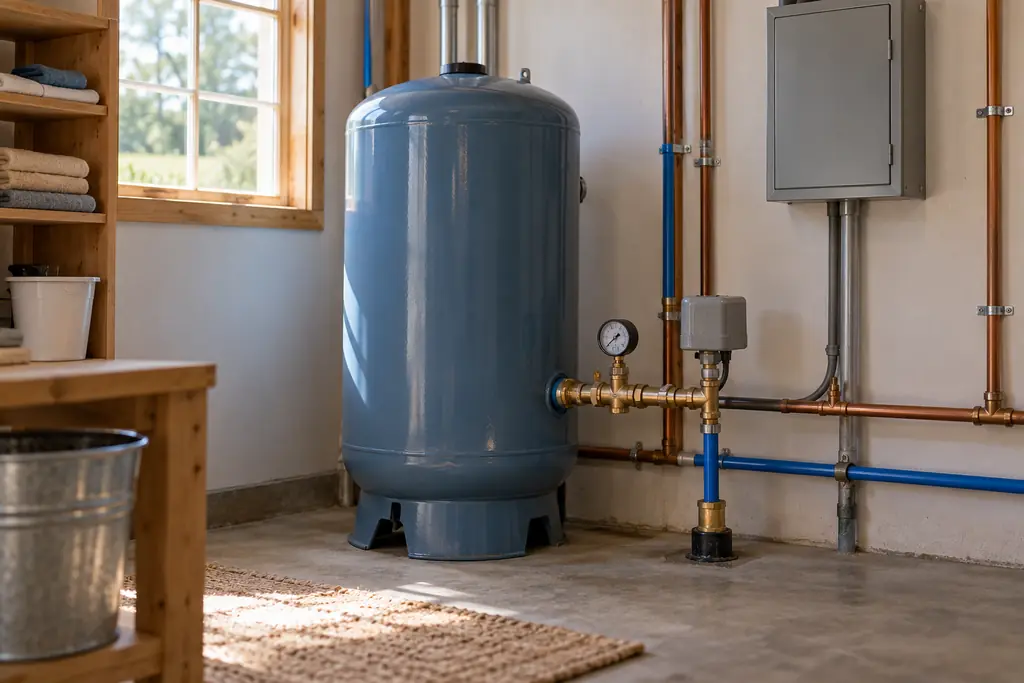
With a pressure tank, the pump motor doesn't have to run every time someone uses water. The tank stores water under pressure and supplies it as you draw from the system. When pressure drops to the level that calls for pumping, the pump starts and restores it.
For battery planning, that means the pump's actual running time depends on your water demand and how your particular system behaves, including how much water the tank delivers between cycles. Two pumps with the same horsepower won't necessarily run for the same amount of time during an outage.
Estimate energy from actual operation
A 240 V, 1/2 HP submersible well pump drawing 655 to 960 W while running uses 1,310 to 1,920 Wh over 2 hours of pumping per day. With 80% to 90% of rated station capacity reaching AC appliances, that requires 1,456 to 2,400 Wh of rated capacity.
At a 960 W running load, the EcoFlow DELTA Pro 3 provides 3.4 to 3.8 hours of pumping, only if the pump's start-up demand fits the station. Use your own pump's running power and start-up figures when checking the capacity and output requirements.
Our battery runtime method assumes 80% to 90% of rated capacity reaches AC appliances, so the rated battery capacity you need is roughly:
- Lower estimate = Required Wh ÷ 0.90
- Higher estimate = Required Wh ÷ 0.80
This estimates energy only. It doesn't confirm that the inverter can start the pump or that its output is electrically compatible. Once you've confirmed the pump's operating consumption, use the runtime calculator.
Why water use changes the result
How much energy a pump uses during an outage depends on how it runs. Consider:
- How often household water is used
- How much water the pressure tank supplies between pump cycles
- How frequently the pump starts
- How long each pumping period lasts
- Whether other equipment in the water system requires electricity
A pressure tank can cut how often the motor runs, but it doesn't add stored energy to the battery or remove the startup demand each time the pump turns on. Base runtime estimates on how your own system behaves, not on a fixed gallons-per-charge claim.
Connecting a hardwired pump safely
A hardwired well pump is connected to household wiring, so you can't simply plug it into a power station's outlet. Never backfeed household wiring. Connecting a portable backup source to a hardwired pump requires listed transfer equipment, such as a transfer switch or an interlock kit with an inlet, installed by a licensed electrician with any required permit.
NEC Article 702 covers optional standby systems and requires transfer equipment designed and installed to prevent inadvertent interconnection of utility and alternate power sources; your area may use an older NEC edition. Transfer switches are evaluated to UL 1008. Interlock kits are evaluated as part of the panelboard under UL 67, and the panelboard must be marked for the specific kit. Your electrician decides on the arrangement and confirms it works with the chosen power station and pump. Read our transfer switch guide before planning a household circuit connection.
What to verify before buying
A well pump backup plan should identify:
- Pump or control box model and voltage
- Running current
- Starting or locked-rotor current, if available
- Pump manufacturer compatibility requirements
- Power station continuous output
- Verified motor startup capability
- Battery capacity and expansion options
- Expected pumping time during the outage
- Compatible transfer equipment and professional installation requirements
- Available recharging options
If you can't verify the pump's starting requirements, don't assume a published surge rating establishes compatibility. For larger systems, compare the whole-house battery backup options, and use our size calculator for battery sizing.
Questions readers ask
Can a portable power station run a well pump?
Possibly. The station has to provide the pump's required voltage and handle both its running and startup demands. Battery capacity alone doesn't establish compatibility.
Do I need a 240V power station for my well pump?
If your pump requires 240V, you need a compatible 240V power source. A 120V-only station doesn't provide native 240V output.
How much battery capacity does a well pump need?
It depends on the pump's actual energy use, how long it runs and how often it starts. Use measured or documented consumption rather than estimating from horsepower alone.
Can I connect a battery directly to a hardwired well pump?
No. A hardwired pump needs an approved connection arrangement, and supplying it from a portable backup source requires listed transfer equipment installed by a licensed electrician with any required permit.
Sources
- Transfer equipment used in optional standby systems, part II, IAEI Magazine