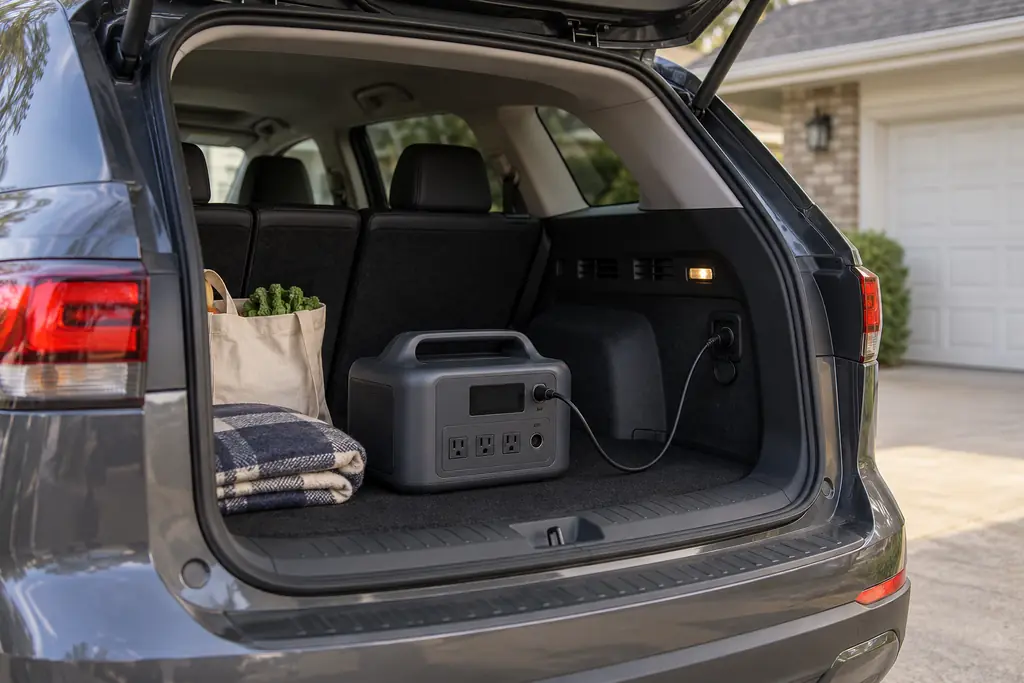
Home battery backup without solar is straightforward: a portable power station stores electricity from whatever charges it and supplies it later through its built-in outlets. The simplest setup is to charge a compatible station from a normal household outlet while the grid is up, then run compatible appliances from it when an outage hits. The catch is that the battery can't refill itself while the grid is down, so you need either enough stored energy for the whole outage or another way to recharge.
Charge before the outage
Start by choosing which appliances need backup electricity. Common priorities include:
- Refrigerator or freezer
- Internet equipment
- Lights
- Phones and chargers
- Compatible medical equipment
- Other essential electrical loads
Calculate their expected energy use, compare it with the power station's capacity, and charge the station according to its manual.
Some power stations offer pass-through power or automatic backup functions, and how these behave depends on the model and the supported connections. Check that the manufacturer permits the charging and backup arrangement you have in mind; don't assume it's fine to leave every portable battery permanently connected to wall power. Follow the manufacturer's storage, charging and battery care instructions, and check the charge level before an expected outage.
How long does a full battery last?
Rated battery capacity is given in watt-hours (Wh), and our AC runtime calculations assume 80% to 90% of it reaches connected AC appliances:
- Lower estimate = Rated Wh × 0.80
- Upper estimate = Rated Wh × 0.90
The current Jackery Explorer 2000 v2 has 2,042 Wh rated capacity, with 1,633.6 to 1,837.8 Wh available to AC appliances. Our runtime calculations assume 80% to 90% of rated capacity reaches AC appliances.
At a refrigerator average of 60 W, the calculated runtime is 27.2 to 30.6 hours. Adding a chest freezer at 24 W brings the combined load to 84 W and reduces the runtime to 19.4 to 21.9 hours.
Use your own appliance's figures rather than relying on these typical loads, especially if the freezer's stated consumption differs.
That gives a range, not a guaranteed runtime, because appliance consumption, operating conditions and conversion losses all change the result. Enter your own appliance measurements in the runtime calculator. For refrigerator backup, also read how long a power station runs a refrigerator.
Compare wall charging specifications
Without solar, AC charging is how you top up before an outage and refill after power returns. These are manufacturer-rated figures, not measured charging results.
| Power station | Capacity | Maximum wall charging input |
|---|---|---|
| Anker SOLIX C1000 Gen 2 | 1,024Wh | 1,600W (UltraFast mode; 1,200W standard) |
| BLUETTI AC180 | 1,152Wh | 1,440W |
| BLUETTI Elite 200 V2 | 2,074Wh | 1,800W |
| EcoFlow DELTA 2 Max | 2,048Wh | 1,800W |
| Anker SOLIX F3800 Plus | 3,840Wh | 1,800W |
| Jackery Explorer 2000 v2 | 2,042Wh | Not stated |
Maximum charging input isn't the same as an independently measured full charging time, and charging behavior can change during the charge. Follow each manufacturer's instructions and published charging conditions. You can compare other battery and output specifications in our power station database.
Recharging when the grid is down
Vehicle charging
Some portable power stations support charging from a vehicle, but available power, compatible cables and supported input depend on the model. The result also depends on the vehicle's operating conditions and available energy.
Read the manufacturer's vehicle charging instructions and use your own appliance's figures to determine how much energy you need. The CDC says never leave the motor running in a vehicle parked in an enclosed or partially enclosed space such as a garage.
Fuel generator charging
Some power stations can recharge from a compatible portable gas generator, so check the station's AC input requirements against the generator's output specifications. The generator must run outdoors, at least 20 feet from doors, windows and vents. Never operate a fuel generator inside the home, and install a battery-operated carbon monoxide detector.
Solar charging later
A wall-charged system still leaves room to add solar charging later. Manufacturers' stated maximum solar inputs include:
- Anker SOLIX C1000 Gen 2: 600W
- BLUETTI AC180: 500W
- EcoFlow DELTA 3 Plus: 1,000W
- Anker SOLIX F3800 Plus: 3,200W
These are maximum input ratings, not guaranteed solar production, and compatible panels have to meet the station's voltage and current requirements. Our solar generator guide covers the solar-specific decisions.
Automatic backup and UPS functions
Some power stations advertise UPS or EPS operation, meaning they switch a supported connected load over to battery when the primary power source drops out. For example, the Anker SOLIX C1000 Gen 2 has a stated 10ms switchover, while the EcoFlow DELTA 2 Max manual lists 30ms. These are manufacturer claims and don't guarantee that every connected appliance will keep running without interruption. For equipment where an interruption matters, check the manufacturer's backup compatibility information and the connected device's requirements. See our CPAP backup guide for medical-device considerations.
Choose capacity around your outage plan
Wall-charged backup works when you can store enough electricity for your priority loads, and for longer outages, recharging becomes part of the decision. A larger battery stores more energy but doesn't remove the need to calculate appliance consumption. Before buying, check continuous output, surge requirements, battery capacity and available charging sources. Start with the size calculator, then review the portable power station database.
Questions readers ask
Can a home backup battery work without solar?
Yes. A portable power station can store electricity charged from a household outlet. Solar panels are optional.
How long will a wall-charged battery last?
It depends on rated capacity, the connected appliances' average power use and conversion losses. Our calculator assumes 80% to 90% of rated capacity reaches AC appliances.
Can I leave a power station plugged in all the time?
Check the manufacturer's instructions for continuous AC connection, charging, storage and pass-through operation, since models don't all behave the same way.
How can I recharge during an outage without solar?
Depending on the model, options may include a compatible vehicle charging source or an outdoor fuel generator. Household AC charging is available again once grid power returns.