CPAP power consumption depends on the setup
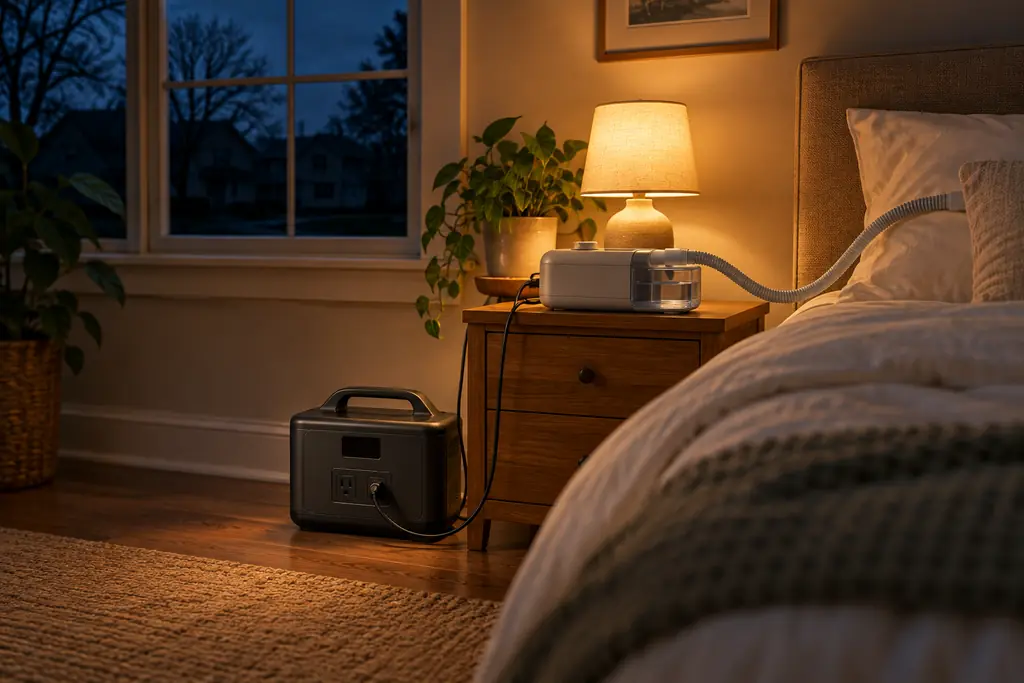
A CPAP machine needs electricity for as long as therapy runs, and during a home outage a portable power station can supply it through a compatible output. How much stored energy you need depends on the CPAP model, its settings, humidification, and any other powered accessories. A battery that runs a CPAP for a long time without heated humidification may last much less once heating is on.
Start with your machine's documentation rather than assuming every CPAP draws the same power. The table above uses the heated-humidifier range, the higher of the two.
CPAP power requirements from manufacturer documentation
Our appliance reference file includes the figures below. They come from manufacturer documentation, not Outlet Powered measurements.
CPAP without heated humidification
The ResMed AirSense 10 battery guide supports a range of 8 to 20W.
CPAP with heated humidification
We use the ResMed AirSense 11 manual's figures for the whole system on AC power: 56.1W typical and 73.2W peak, under its stated conditions. ResMed's battery guide lists about 21W for an AirSense 10 with the humidifier on a low setting, but that was measured through ResMed's DC-to-DC converter, so it applies only to that DC setup.
ResMed AirMini
The US user guide specifies:
- Typical consumption: 6.3W
- Peak consumption: 27W
These figures are model-specific. Don't apply the AirMini's typical consumption to an AirSense machine, or assume every AirSense configuration has the same load.
How the humidifier and heated tube affect runtime
Heating functions change how much electricity a CPAP system uses. A battery holds a fixed amount of rated energy, so as average power consumption rises, estimated runtime falls. Our appliance figures separate operation without humidification from operation with a heated humidifier, and a heated tube may add to the load too. Check your CPAP manual for the configuration you use, and don't assume the lowest published wattage applies when heated accessories are on.
If you're thinking about changing humidification or heating settings to save energy, discuss it with your clinician or equipment provider first.
How we calculate CPAP battery runtime
Power station capacity is stated in watt-hours (Wh). Outlet Powered assumes 80% to 90% of rated capacity reaches appliances connected through AC output, which gives:
- Lower estimate of available AC energy: battery Wh × 0.80
- Upper estimate of available AC energy: battery Wh × 0.90
- Estimated runtime: available AC Wh ÷ average CPAP power (W)
The calculator applies these power consumption assumptions to produce a range. Actual runtime depends on the machine's consumption, connected accessories, and power station behavior, so treat the result as a planning estimate, not a medical backup guarantee.
Example: EcoFlow RIVER 3 Plus
The EcoFlow RIVER 3 Plus has a rated capacity of 286Wh. Using our appliance ranges and AC energy assumptions:
- Without heated humidification: About 11 to 32 hours
- With heated humidification: About 3 to 4.5 hours
That gap matters when you're choosing a small portable battery. The longer estimate isn't the expected result for every CPAP user, and under higher consumption the same battery may run for much less time.
Example: larger power stations
Our calculated reference ranges include:
| Power station | Rated capacity | CPAP with heated humidifier |
|---|---|---|
| Anker SOLIX C1000 Gen 2 | 1,024Wh | About 11 to 16 hours |
| Jackery Explorer 2000 v2 | 2,042Wh | About 22 to 33 hours |
These ranges are calculated from the supplied appliance data. They aren't measured runtimes for specific CPAP and battery combinations. The runtime table above shows the same calculation for every model in our database, and our runtime calculator gives a personalized estimate.
AC power versus DC power
Some CPAP machines have manufacturer-supported DC power options. Depending on the machine, an approved DC adapter may allow operation without using the power station's AC inverter. Adapter compatibility and electrical requirements are model-specific, though, so check the CPAP manufacturer's approved adapter information before connecting a DC power source. A connector that fits, or a matching voltage, doesn't establish compatibility on its own.
Our runtime examples use the 80% to 90% AC energy assumption, so don't reuse those ranges as verified DC runtime figures.
ResMed's battery guide strongly recommends its DC-to-DC converter over a DC-to-AC inverter when you run one of its machines from a battery. The FDA advises asking the device maker or supplier whether the device can run on batteries or a generator, and checking its settings after power returns; if the device is life-sustaining, seek emergency help. At small loads like a CPAP, the station's own idle draw takes a large share of the energy, so actual runtime can fall well below our estimates.
UPS and EPS switchover limitations
Some portable power stations advertise UPS or EPS functionality. For example:
- EcoFlow RIVER 3 Plus: Stated 10ms
- Anker SOLIX C1000 Gen 2: Stated 10ms
- Jackery Explorer 2000 v2: Stated under 20ms
These are manufacturer claims. They don't establish that a connected CPAP will keep running through a power interruption, because different devices respond differently to a change in their power supply. A power station that advertises UPS functionality shouldn't be treated as a medically validated backup system.
Make a separate plan for medical equipment
Battery capacity is only one part of a CPAP outage plan. Before relying on a portable power station:
- Identify the exact CPAP model.
- Check its power requirements.
- Include the humidifier and heated tube configuration.
- Confirm approved AC or DC power options.
- Check the power station's backup behavior.
- Plan for the possibility of a longer outage.
- Discuss backup arrangements with your clinician or equipment provider.
Also work out how you'll recharge the battery if electricity stays unavailable. Above all, confirm your CPAP's power requirements and backup recommendations with its manufacturer or your equipment provider: a calculated runtime helps with sizing, but it doesn't replace a confirmed medical-device backup plan. For model comparisons, see our CPAP power station buying guide.
Questions readers ask
How many watts does a CPAP use?
Our ResMed AirSense 10 reference lists 8 to 20W without humidification, and for heated humidification we use the AirSense 11 figures of 56.1W typical and 73.2W peak. Consumption depends on the model, settings, and accessories.
Can a small power station run a CPAP all night?
Possibly, depending on the machine's power consumption and the battery capacity. The EcoFlow RIVER 3 Plus has an estimated 3 to 4.5 hours with heated humidification, so it will not cover a full night with heating on.
Does turning off the humidifier increase runtime?
Heated humidification affects power consumption, and our reference ranges show lower power use without it. Discuss any change to therapy settings with your clinician or equipment provider.
Is a power station with a 10ms UPS safe for CPAP?
A 10ms rating is a manufacturer's switchover claim, not a guarantee that your CPAP will operate without interruption. Confirm compatibility with the CPAP manufacturer and your equipment provider.