Which one to choose
Choose the C1000 Gen 2 if
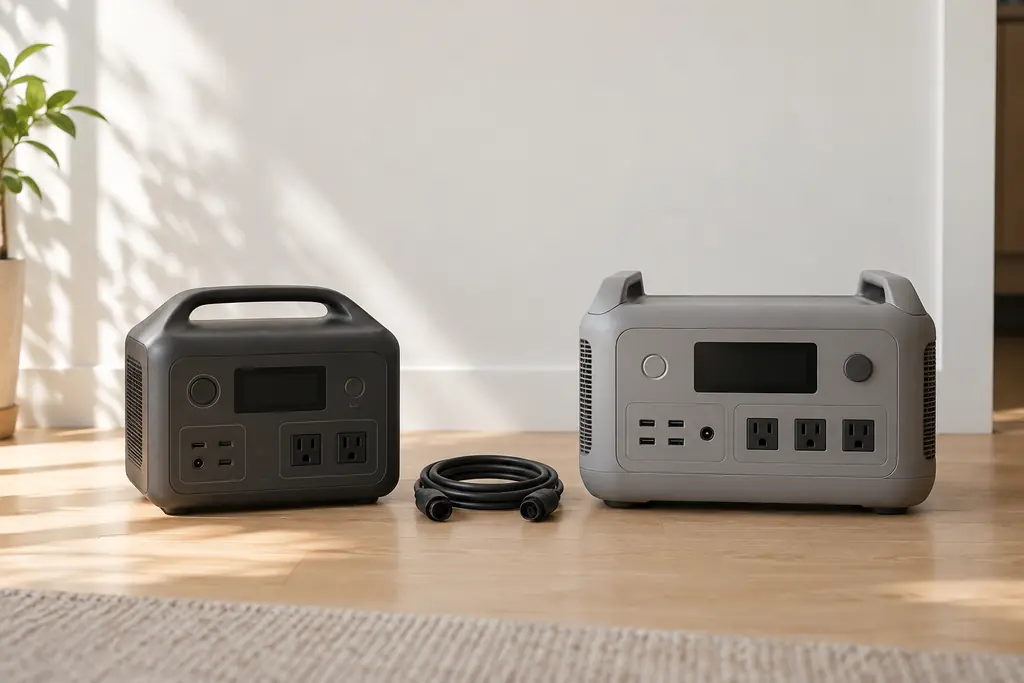
Choose the C1000 Gen 2 if your outage list needs up to 2,000 W of continuous AC output and you do not plan to add a battery later. Its 10 ms UPS switchover is shorter than the C1000's 20 ms, and its 24.9 lb weight matters if you need to move it between storage and the appliances on your list. It has 1,024 Wh of capacity, so the higher output rating does not give it a longer calculated runtime at the same load. Its faster full-charge claim also makes it the model to consider when charging time matters, provided you account for the temperature condition on UltraFast charging.
Choose the C1000 if
Choose the C1000 if adding the BP1000 Expansion Battery is part of your outage plan. The battery raises the original unit from 1,056 Wh to 2,112 Wh, while the Gen 2 cannot expand, so this decision cannot be postponed by buying the Gen 2 first. Without expansion, the original unit has 32 Wh more rated capacity, but its continuous AC output is 1,800 W rather than 2,000 W. It also weighs 28.44 lb and has a 20 ms UPS switchover, which may matter more than the capacity difference for some appliance lists.
What changed between the two
| Decision point | C1000 | C1000 Gen 2 |
|---|---|---|
| Continuous AC output | 1,800 W | 2,000 W |
| Capacity and expansion | 1,056 Wh; BP1000 expansion to 2,112 Wh | 1,024 Wh; not expandable |
| Wall charging | 1,000 W standard, 1,300 W UltraFast; fastest full charge 58 minutes | 1,200 W standard, 1,600 W UltraFast; fastest full charge 49 minutes |
| UPS switchover | 20 ms | 10 ms |
| Weight | 28.44 lb | 24.9 lb, or 3.5 lb lighter |
Both use LFP batteries, offer up to 600 W of solar input, have a 5-year warranty and provide 120 V AC only. Their solar inputs differ, with one XT-60 input on the C1000 and one XT60i input on the Gen 2, along with different voltage and current limits. Anker states 3,000 cycles to 80% capacity for the C1000 and 4,000 cycles to at least 80% for the Gen 2.
Runtime in an outage
For the same average appliance load, the original C1000's 1,056 Wh capacity gives a slightly longer calculated runtime than the Gen 2's 1,024 Wh capacity. The runtimes are our calculation for the stated loads and assume 80% to 90% of rated capacity reaches AC appliances.
- Refrigerator at 60 W average: C1000, 14.1 to 15.8 hours; C1000 Gen 2, 13.7 to 15.4 hours.
- Refrigerator plus chest freezer at 84 W: C1000, 10.1 to 11.3 hours; C1000 Gen 2, 9.8 to 11.0 hours.
- CPAP with heated humidifier, 8-hour nights at 56.1 W: C1000, 1.9 to 2.1 nights; C1000 Gen 2, 1.8 to 2.1 nights.
- C1000 with BP1000 expansion, refrigerator at 60 W: 2,112 Wh: 28.2 to 31.7 hours. The Gen 2 is not expandable.
The refrigerator guide provides more context for that appliance load, while the CPAP guide covers the other stated planning case. In a plan covering a refrigerator and chest freezer together, compare the combined 84 W figure with the single-refrigerator figure before deciding how much stored energy you want. If the expanded refrigerator runtime is the reason you are considering the older unit, the BP1000 must be part of that plan; the C1000 alone still has 1,056 Wh. For other loads, use the runtime calculator to make a separate estimate.
Charging in the cold
UltraFast charging must be enabled in the app on both models, and the Gen 2 requires its battery to be above 68°F for UltraFast to work. That condition matters if the unit is kept in a cold garage in winter, because the Gen 2's 49-minute fastest full-charge figure should be read alongside the stated temperature requirement. The C1000's UltraFast rating is 1,300 W and its fastest full charge is 58 minutes; the Gen 2's figures are 1,600 W and 49 minutes. Both support car charging, but the wattage is not stated by Anker for either, and the Gen 2 car charging cable is sold separately.
The surge figure Anker reports two ways
Anker's C1000 page lists 2,400 W surge, while the comparison table on Anker's C1000 Gen 2 page lists the C1000 at 3,000 W peak; we use 2,400 W. Anker lists 3,000 W peak for the Gen 2 on its product page, although that figure is not in its manual. Both models offer SurgePad boost up to 2,400 W, unavailable in bypass mode, so keep that boost figure separate from the continuous AC output rating. For the steady appliance load in an outage plan, compare 1,800 W continuous for the C1000 against 2,000 W continuous for the Gen 2.
Telling them apart in a listing
The full model name is the only reliable check, because a listing shortened to "C1000" may describe either generation. The EcoFlow vs Anker SOLIX comparison covers the C1000 Gen 2, and the Black Friday buying checklist can help when reading seasonal listings. The C1000 lists six AC outlets; the Gen 2 lists 10 total ports, but its AC outlet count is not stated by Anker. Confirm the full model name first, then check expansion support and continuous AC output: the C1000 accepts the BP1000 and delivers 1,800 W, while the C1000 Gen 2 is not expandable and delivers 2,000 W.
Questions readers ask
Is the C1000 Gen 2 expandable?
No. Anker's FAQ says the Gen 2 is not expandable, while the original C1000 accepts the BP1000 Expansion Battery and reaches 2,112 Wh.
Is the C1000 discontinued?
The C1000 is the older, superseded model, but it was still sold on Anker's US store when checked on 2026-10-09. The C1000 Gen 2 was the current model at that check.
Which one has a faster UPS switchover?
The Gen 2 has a 10 ms UPS switchover, compared with 20 ms for the original C1000. Both figures come from Anker's manuals.
Do I have to enable UltraFast charging in the app?
Yes, UltraFast charging must be enabled in the app on both models. The Gen 2 also requires its battery to be above 68°F for UltraFast charging to work.