Comparison

EcoFlow vs Anker SOLIX for home backup

EcoFlow DELTA 3 Plus and DELTA Pro 3 against Anker SOLIX C1000 Gen 2 and F3800 Plus, compared on output, expansion, solar charging and weight.

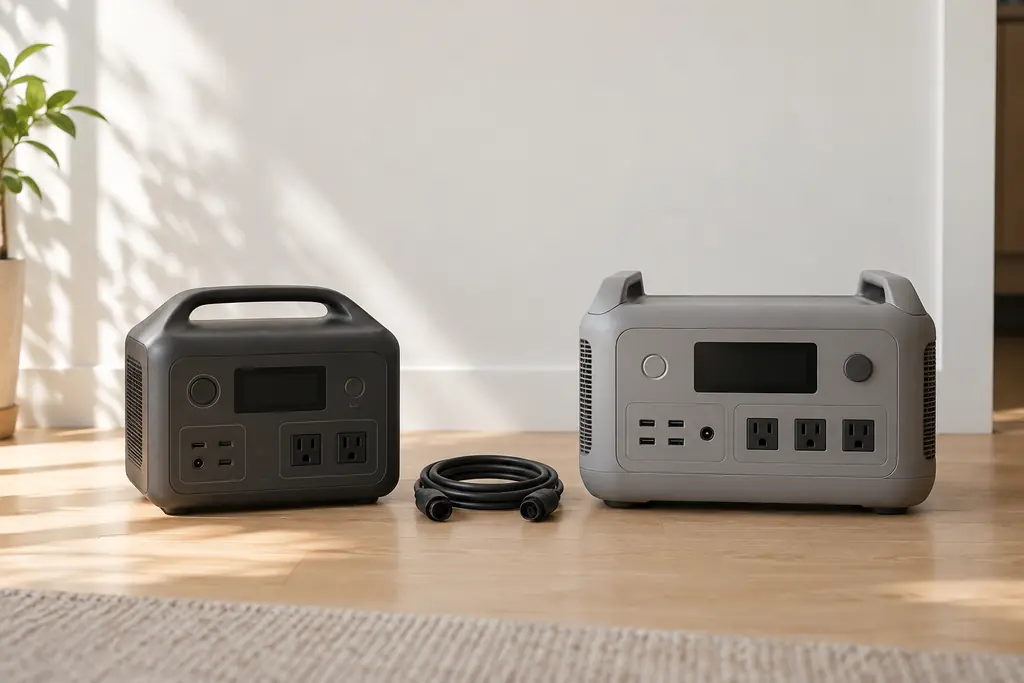
Two portable power stations of different sizes side by side on a wooden floor, with a coiled charging cable between them
Illustration

Quick answer

With 1,000 W solar input, EcoFlow DELTA 3 Plus accepts more than Anker SOLIX C1000 Gen 2 at 600 W; C1000 Gen 2 provides 2,000 W continuous versus 1,800 W. At 120/240 V, F3800 Plus offers 6,000 W continuous versus 4,000 W on DELTA Pro 3, while DELTA Pro 3 stores 4,096 Wh versus 3,840 Wh.

At a glance: the headline specs

Battery capacity

  • EcoFlow DELTA 3 Plus1,024 Wh
  • Anker SOLIX C1000 Gen 21,024 Wh
  • EcoFlow DELTA Pro 34,096 Wh
  • Anker SOLIX F3800 Plus3,840 Wh

AC output, continuous

  • EcoFlow DELTA 3 Plus1,800 W
  • Anker SOLIX C1000 Gen 22,000 W
  • EcoFlow DELTA Pro 34,000 W
  • Anker SOLIX F3800 Plus6,000 W

AC surge

  • EcoFlow DELTA 3 Plus3,600 W
  • Anker SOLIX C1000 Gen 23,000 W
  • EcoFlow DELTA Pro 38,000 W
  • Anker SOLIX F3800 PlusNot stated

Solar input, max

  • EcoFlow DELTA 3 Plus1,000 W
  • Anker SOLIX C1000 Gen 2600 W
  • EcoFlow DELTA Pro 32,600 W
  • Anker SOLIX F3800 Plus3,200 W

Wall charging, max

  • EcoFlow DELTA 3 Plus1,500 W
  • Anker SOLIX C1000 Gen 21,600 W
  • EcoFlow DELTA Pro 3Not stated
  • Anker SOLIX F3800 Plus1,800 W

Weight

  • EcoFlow DELTA 3 Plus27.6 lb
  • Anker SOLIX C1000 Gen 224.9 lb
  • EcoFlow DELTA Pro 3113.54 lb
  • Anker SOLIX F3800 Plus135.6 lb
Side-by-side specs (rows that differ are highlighted)
SpecEcoFlow DELTA 3 PlusAnker SOLIX C1000 Gen 2EcoFlow DELTA Pro 3Anker SOLIX F3800 Plus
Battery capacity (differs)1,024 Wh[source: EcoFlow DELTA 3 Plus user manual (online, US)]1,024 Wh[source: Anker SOLIX C1000 Gen 2 User Guide (A1763), US version (A17631A1_US_UG_V2)]4,096 Wh[source: EcoFlow DELTA Pro 3 user manual (online, US)]3,840 Wh[source: Anker SOLIX F3800 Plus User Guide (A1790P)]
ChemistryLiFePO4 (LFP)[source: EcoFlow DELTA 3 Plus user manual (online, US)]LiFePO4 (LFP)[source: What battery does Anker SOLIX C1000 Gen 2 use? (Anker SOLIX support)]LiFePO4 (LFP)[source: EcoFlow DELTA Pro 3 user manual (online, US)]LiFePO4 (LFP)[source: Anker SOLIX F3800 Plus User Guide (A1790P)]
Cycle life (maker claim) (differs)4,000 cycles to 80%[source: EcoFlow DELTA 3 Plus user manual (online, US)]4,000 cycles to 80%[source: Anker SOLIX C1000 Gen 2 product page (US)]4,000 cycles to 80%[source: EcoFlow DELTA Pro 3 user manual (online, US)]3,000 cycles[source: Anker SOLIX F3800 Plus product page (US)]
AC output, continuous (differs)1,800 W[source: EcoFlow DELTA 3 Plus user manual (online, US)]2,000 W[source: Anker SOLIX C1000 Gen 2 User Guide (A1763), US version (A17631A1_US_UG_V2)]4,000 W[source: EcoFlow DELTA Pro 3 user manual (online, US)]6,000 W[source: Anker SOLIX F3800 Plus User Guide (A1790P)]
AC surge / peak (differs)3,600 W[source: EcoFlow DELTA 3 Plus user manual (online, US)]3,000 W[source: Anker SOLIX C1000 Gen 2 product page (US)]8,000 W[source: EcoFlow DELTA Pro 3 user manual (online, US)]Not stated
Boost mode (differs)X-Boost, up to 2,200 W[source: EcoFlow DELTA 3 Plus product page (US)] (The US manual gives 2,600 W at 120 V; the spec table gives 2,200 W)SurgePad, up to 2,400 W[source: Anker SOLIX C1000 Gen 2 User Guide (A1763), US version (A17631A1_US_UG_V2)]X-Boost, up to 6,000 W[source: EcoFlow DELTA Pro 3 user manual (online, US)]Not stated
AC outlets (differs)6[source: EcoFlow DELTA 3 Plus product page (US)]Not stated7[source: EcoFlow DELTA Pro 3 user manual (online, US)]8[source: Anker SOLIX F3800 Plus User Guide (A1790P)]
RV / 240 V outlets (differs)None[source: EcoFlow DELTA 3 Plus product page (US)]Not statedNEMA 5-20R, TT-30R, L14-30R, NEMA 6-20R[source: EcoFlow DELTA Pro 3 user manual (online, US)]NEMA 5-20R, TT-30R, L14-30R[source: Anker SOLIX F3800 Plus User Guide (A1790P)]
Output voltage (differs)120 V[source: EcoFlow DELTA 3 Plus user manual (online, US)]120 V[source: Anker SOLIX C1000 Gen 2 User Guide (A1763), US version (A17631A1_US_UG_V2)]120 V and 240 V[source: EcoFlow DELTA Pro 3 user manual (online, US)]120 V and 240 V[source: Anker SOLIX F3800 Plus User Guide (A1790P)]
Wall charging, max (differs)1,500 W[source: EcoFlow DELTA 3 Plus product page (US)]1,600 W[source: Anker SOLIX C1000 Gen 2 User Guide (A1763), US version (A17631A1_US_UG_V2)]Not stated1,800 W[source: Anker SOLIX F3800 Plus User Guide (A1790P)]
Fastest full charge (wall) (differs)56 min[source: EcoFlow DELTA 3 Plus product page (US)]49 min[source: Anker SOLIX C1000 Gen 2 product page (US)]Not statedNot stated
Solar input, max (differs)1,000 W[source: EcoFlow DELTA 3 Plus user manual (online, US)]600 W[source: Anker SOLIX C1000 Gen 2 User Guide (A1763), US version (A17631A1_US_UG_V2)]2,600 W[source: EcoFlow DELTA Pro 3 product page (US)]3,200 W[source: Anker SOLIX F3800 Plus product page (US)]
Solar voltage range (differs)11 to 60 V[source: EcoFlow DELTA 3 Plus user manual (online, US)]11 to 60 V[source: Anker SOLIX C1000 Gen 2 User Guide (A1763), US version (A17631A1_US_UG_V2)]30 to 150 V / 11 to 60 V[source: EcoFlow DELTA Pro 3 user manual (online, US)] (two inputs: high voltage and low voltage)11 to 165 V[source: Anker SOLIX F3800 Plus User Guide (A1790P)]
Solar current, max (differs)15 A[source: EcoFlow DELTA 3 Plus user manual (online, US)]14.5 A[source: Anker SOLIX C1000 Gen 2 User Guide (A1763), US version (A17631A1_US_UG_V2)]20 A[source: EcoFlow DELTA Pro 3 user manual (online, US)]17 A[source: Anker SOLIX F3800 Plus User Guide (A1790P)]
Car chargingNot statedNot statedNot statedNot stated
Expandable to (differs)5,000 Wh[source: EcoFlow DELTA 3 Plus product page (US)] (stated as about 5 kWh)Not stated12,000 Wh[source: EcoFlow DELTA Pro 3 product page (US)]26,880 Wh[source: Anker SOLIX F3800 Plus User Guide (A1790P)]
Expansion battery (differs)DELTA 3 Extra Battery, DELTA 2 Extra Battery, DELTA 2 Max Extra Battery, DELTA Pro 3 Extra Battery[source: EcoFlow DELTA 3 Plus product page (US)]Not statedDELTA Pro 3 Smart Extra Battery[source: EcoFlow DELTA Pro 3 user manual (online, US)]Anker SOLIX BP3800 Expansion Battery[source: Anker SOLIX F3800 Plus User Guide (A1790P)]
UPS / EPS switchover (differs)10 ms[source: EcoFlow DELTA 3 Plus product page (US)]10 ms[source: Anker SOLIX C1000 Gen 2 User Guide (A1763), US version (A17631A1_US_UG_V2)]10 ms[source: EcoFlow DELTA Pro 3 user manual (online, US)]20 ms[source: Anker SOLIX F3800 Plus User Guide (A1790P)] (three leftmost 5-20R outlets, on wall power only)
Weight (differs)27.6 lb[source: EcoFlow DELTA 3 Plus user manual (online, US)]24.9 lb[source: Anker SOLIX C1000 Gen 2 User Guide (A1763), US version (A17631A1_US_UG_V2)]113.54 lb[source: EcoFlow DELTA Pro 3 user manual (online, US)]135.6 lb[source: Anker SOLIX F3800 Plus User Guide (A1790P)]
Warranty5 years[source: EcoFlow DELTA 3 Plus user manual (online, US)]5 years[source: Anker SOLIX Portable Power Station Warranty Policy - United States]5 years[source: EcoFlow DELTA Pro 3 product page (US)] (3 years, plus 2 with registration in the EcoFlow app)5 years[source: Anker SOLIX F3800 Plus product page (US)]

How to choose

For DELTA 3 Plus versus C1000 Gen 2, solar input is 1,000 W versus 600 W. Continuous AC output favors C1000 Gen 2 at 2,000 W versus 1,800 W. For DELTA Pro 3 versus F3800 Plus, continuous output is 4,000 W versus 6,000 W. F3800 Plus supports expansion to 26,880 Wh versus 12 kWh with two extra batteries on DELTA Pro 3.

DELTA 3 Plus vs C1000 Gen 2

Both power stations have 1,024Wh of rated capacity, use LFP batteries and claim 4,000 cycles to 80% remaining capacity. Their calculated runtime for a refrigerator averaging 60W is identical, at 13.7 to 15.4 hours, assuming 80% to 90% of rated capacity reaches AC appliances. That range doesn't show that either unit can start a particular refrigerator. With the batteries matched, output, expansion, charging and weight are what separate them.

Output and boost modes

The Anker SOLIX C1000 Gen 2 supplies 2,000W continuous output and the EcoFlow DELTA 3 Plus supplies 1,800W, so Anker leads on continuous output in this pair. EcoFlow lists the higher surge rating, though: 3,600W against Anker's 3,000W.

Each brand also has its own boost mode: X-Boost at 2,200W on the DELTA 3 Plus and SurgePad at 2,400W on the C1000 Gen 2. These are manufacturer-specific features, so don't treat a boost-mode wattage as interchangeable with continuous output or a surge rating. Check the appliance and the conditions attached to each mode.

Solar input and expansion

The DELTA 3 Plus accepts up to 1,000W of solar input and the C1000 Gen 2 up to 600W, both within an 11 to 60V range. EcoFlow also expands to approximately 5kWh with compatible batteries, while Anker states the C1000 Gen 2 isn't expandable. If you expect to add stored energy later, that favors the DELTA 3 Plus.

EcoFlow's higher solar rating also gives you more room when planning a larger compatible solar setup, though it doesn't guarantee more production in poor sunlight.

Wall charging and portability

Anker lists up to 1,600W of wall charging in UltraFast mode (1,200W standard), against 1,500W for EcoFlow. The fastest stated full charging times, both manufacturer claims under their own charging conditions, are:

  • C1000 Gen 2: 49 minutes in UltraFast mode
  • DELTA 3 Plus: 56 minutes

The C1000 Gen 2 weighs 24.9 lb and the DELTA 3 Plus 27.6 lb. For portable use, Anker has the lower weight and the higher continuous output. For home backup you can grow later, EcoFlow gives you more documented flexibility.

DELTA Pro 3 vs F3800 Plus

Both larger systems provide 120/240V output, which makes them candidates for home backup plans that include compatible 240V equipment. The DELTA Pro 3 stores 4,096Wh and the F3800 Plus 3,840Wh. For a refrigerator averaging 60W, that works out to:

  • DELTA Pro 3: 54.6 to 61.4 hours
  • F3800 Plus: 51.2 to 57.6 hours

So the DELTA Pro 3 has a modest calculated runtime advantage before expansion. Whether either one can run a given appliance still needs checking separately.

Continuous output and surge

The F3800 Plus provides 6,000W continuous AC output and the DELTA Pro 3 provides 4,000W, so Anker has the higher published continuous output. EcoFlow lists an 8,000W surge rating and a 6,000W X-Boost mode. Our verified data has no separate surge rating for the F3800 Plus, and an absent rating doesn't mean zero surge capability. Don't assume either system will run a specific motor or large appliance until you've checked its starting requirements.

Expansion and solar charging

Anker supports expansion to 26,880Wh and EcoFlow to 12,000Wh, so the F3800 Plus has the higher documented expansion limit in our database. Anker also lists up to 3,200W of solar input, against EcoFlow's 2,600W across two inputs.

The voltage requirements differ as well. EcoFlow has separate high-voltage and low-voltage solar inputs, while Anker lists a single 11 to 165V range. Check each manufacturer's input and panel compatibility requirements before you plan either setup.

Weight

The DELTA Pro 3 weighs 113.5 lb and the F3800 Plus 135.6 lb, which makes EcoFlow 22.1 lb lighter on the stated specifications. Both are heavy, so think about where each would live and whether you'll need to move it. For the full head-to-head, read DELTA Pro 3 vs F3800 Plus.

Warranty and cycle-life claims

The DELTA 3 Plus and C1000 Gen 2 both list five-year warranties and 4,000 cycles to 80% remaining battery capacity. The larger models differ. The DELTA Pro 3 claims 4,000 cycles to 80%, while the F3800 Plus lists 3,000 cycles without stating the remaining-capacity percentage, so the counts aren't directly comparable. The F3800 Plus has a five-year warranty, and the DELTA Pro 3 lists three years plus two more with registration in the EcoFlow app.

UPS claims have different conditions

The DELTA 3 Plus, C1000 Gen 2 and DELTA Pro 3 each list a 10ms switchover. The F3800 Plus lists 20ms, but only for its three leftmost NEMA 5-20R outlets while running on wall power under the stated conditions, so that rating doesn't apply to every F3800 Plus outlet. All of these are manufacturer claims, and none guarantees uninterrupted operation for a particular medical device or computer.

Our call

DELTA 3 Plus is the choice for charging from panels and adding batteries later, with expansion stated at about 5 kWh. C1000 Gen 2 suits someone prioritizing continuous output in a lighter station, weighing 24.9 lb versus 27.6 lb for DELTA 3 Plus. The older Anker SOLIX C1000 expands to 2,112 Wh with the BP1000 while Gen 2 does not; see C1000 vs C1000 Gen 2.

For a planned 240 V load with greater continuous demand, F3800 Plus is the model to examine, although its 240 V output is unavailable while charging from 120 V AC. DELTA Pro 3 offers a stated 8,000 W surge rating and 10 ms UPS, compared with surge not stated by Anker and 20 ms UPS on three outlets with wall power only for F3800 Plus.

Questions readers ask

Is EcoFlow or Anker SOLIX better for home backup?

It depends on the model and your loads. The DELTA 3 Plus can expand and the C1000 Gen 2 can't. In the larger class, the F3800 Plus has more continuous output and expansion than the DELTA Pro 3.

Which charges faster from solar?

The DELTA 3 Plus supports 1,000W solar input versus 600W for the C1000 Gen 2. The F3800 Plus supports 3,200W versus 2,600W for the DELTA Pro 3. These are input limits, not actual charging results.

Which is lighter?

The C1000 Gen 2 weighs 24.9 lb versus 27.6 lb for the DELTA 3 Plus. Among the larger models, the DELTA Pro 3 weighs 113.5 lb versus 135.6 lb for the F3800 Plus.

Do both brands support 240V backup?

The DELTA Pro 3 and F3800 Plus provide 120/240V output. The DELTA 3 Plus and C1000 Gen 2 provide 120V only. Powering home circuits requires approved transfer equipment installed by a licensed electrician with any required permit.