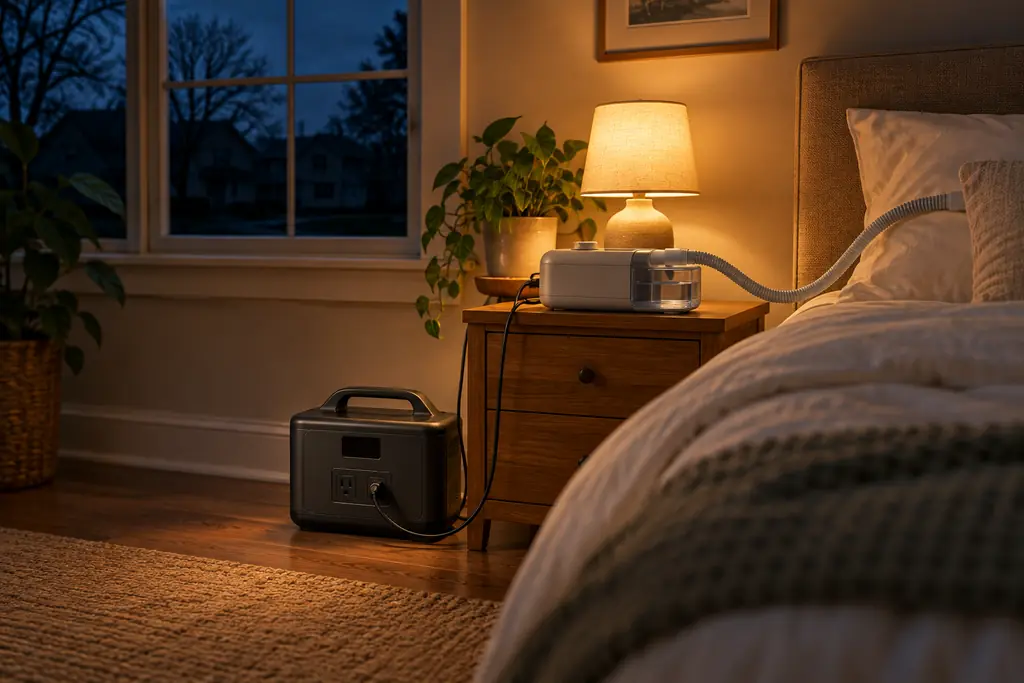
How we chose these power stations
CPAP backup is a narrower job than general household power station shopping. The question is whether a battery can supply a compatible CPAP for as long as you need it. We compared:
- Battery capacity for overnight use with heated humidification
- Weight and portability
- Manufacturer-stated UPS switchover
- Wall charging capability
- Expansion support where stated
The picks above use manufacturer specifications and our calculated runtime method. Outlet Powered doesn't physically test products, so a model's place in this guide doesn't mean we've verified its performance with a particular CPAP. The smaller RIVER 3 Plus is here for portability, even though its runtime is limited under higher humidifier loads.
How much battery capacity do you need?
Our reference appliance data includes:
- CPAP without humidifier: 8 to 20W
- CPAP with heated humidifier (AirSense 11 on AC): 56.1W typical, 73.2W peak
- ResMed AirMini: 6.3W typical, 27W peak
The first range comes from the ResMed AirSense 10 battery guide. The heated-humidifier figures come from the ResMed AirSense 11 manual, which states 56.1W typical and 73.2W peak consumption for the whole system on AC power. The roughly 21W figure in ResMed's battery guide was measured through its DC-to-DC converter, so we do not use it for runtimes from an AC outlet. Don't assume every CPAP draws the same power: the capacity you need depends on your machine, its configuration, and how long it has to run.
Sizing for a night with heated humidification
Take an illustrative 8-hour night. At the AirSense 11's 56.1W typical draw the machine uses about 56.1 × 8 = 449Wh, and at its 73.2W peak about 73.2 × 8 = 586Wh. These are constant-load calculations at the two ends of the range, not measured overnight energy consumption.
Our runtime method assumes 80% to 90% of rated battery capacity reaches AC appliances. For the higher-load example:
- 586 ÷ 0.90 = approximately 651Wh
- 586 ÷ 0.80 = approximately 733Wh
That gives a rated-capacity planning range of about 651 to 733Wh for the illustrative load. It's a capacity calculation only. It doesn't account for device compatibility, power conversion, or how your machine behaves in use, and it doesn't establish uninterrupted therapy.
Compare the runtime ranges
Here are our calculated examples:
| Power station | Rated capacity | Without humidifier | With heated humidifier |
|---|---|---|---|
| EcoFlow RIVER 3 Plus | 286Wh | About 11 to 32 hours | About 3 to 4.5 hours |
| Anker SOLIX C1000 Gen 2 | 1,024Wh | About 41 to 115 hours | About 11 to 16 hours |
| Jackery Explorer 2000 v2 | 2,042Wh | About 82 to 230 hours | About 22 to 33 hours |
The ranges without a humidifier are broad because that draw depends on the pressure setting, and the upper end of each isn't a guaranteed outcome. The C1000 Gen 2's lower estimate is about 11 hours with heated humidification, which is why its label says a night or more rather than several nights. Enter your own CPAP's power figures in the runtime calculator.
Weight matters during an outage
You may need to move the battery between rooms or take it with you if you leave home. Our picks range from the 10.36 lb EcoFlow RIVER 3 Plus to the 39.5 lb Jackery Explorer 2000 v2. The lighter unit holds less built-in energy, while the larger Jackery holds more rated capacity but is heavier to carry. Choose based on the energy you need and the weight you can reasonably handle.
Understand the UPS claims
The selected models advertise these switchover times:
- EcoFlow RIVER 3 Plus: 10ms
- Anker SOLIX C1000 Gen 2: 10ms
- Jackery Explorer 1000 v2: Under 20ms
- Jackery Explorer 2000 v2: Under 20ms
These are manufacturer claims, not results measured by Outlet Powered. A power station that advertises UPS or EPS operation isn't automatically suitable for uninterrupted CPAP therapy, because the CPAP may respond differently depending on its own electrical requirements. Before you rely on any power station, ask your CPAP manufacturer or equipment provider whether it's compatible and which backup arrangements they approve.
AC versus DC power
Some CPAP machines support manufacturer-approved DC power adapters. An approved DC setup may avoid using the power station's AC inverter, but compatibility depends on the specific equipment, so don't use an unverified adapter based only on connector shape or nominal voltage. Our runtime examples assume AC output with 80% to 90% of rated battery capacity available to appliances, so they shouldn't be read as measured or guaranteed DC runtimes.
ResMed's battery guide strongly recommends its DC-to-DC converter over a DC-to-AC inverter when you run one of its machines from a battery. The FDA advises asking the device maker or supplier whether the device can run on batteries or a generator, and checking its settings after power returns; if the device is life-sustaining, seek emergency help. At small loads like a CPAP, the station's own idle draw takes a large share of the energy, so actual runtime can fall well below our estimates.
What to avoid when choosing CPAP backup
Don't pick a battery on capacity alone. Common problems include:
- Assuming a small battery will always last overnight with a heated humidifier
- Applying another CPAP model's power consumption to your machine
- Treating UPS switchover claims as medical-device guarantees
- Using a DC adapter without manufacturer approval
- Ignoring the power required by heated accessories
- Buying without a plan for recharging during an extended outage
A larger battery can't fix an incompatible electrical connection, and a fast advertised UPS time is no substitute for the manufacturer's confirmation.
Plan for an extended outage
For longer outages, plan how you'll recharge the battery. Check which AC, vehicle, and solar charging options your model supports, and keep in mind that maximum charging input doesn't tell you how much energy you'll get back during an actual outage. If your therapy depends on continuous electrical power, discuss an emergency plan with your clinician or equipment provider.
For more on CPAP power consumption, read how long a power station runs a CPAP. Choose your backup around the CPAP you use, the configuration your therapy needs, and a confirmed backup arrangement.
Questions readers ask
What size power station do I need for CPAP with a humidifier?
With heated humidification we use the ResMed AirSense 11 figures of 56.1W typical and 73.2W peak on AC power. Work out the energy needed for your operating hours, then allow for AC conversion losses using our 80% to 90% assumption.
Will a 286Wh power station run CPAP all night?
It depends on consumption. The EcoFlow RIVER 3 Plus has calculated runtimes of 11 to 32 hours without humidification and 3 to 4.5 hours with heated humidification, so it will not cover a full night with heating on.
Is a 10ms UPS rating enough for CPAP?
A manufacturer's 10ms claim doesn't guarantee uninterrupted therapy. Check your CPAP manufacturer's power requirements and backup recommendations before relying on any portable station.
Is a larger CPAP backup battery worth the extra weight?
More capacity can support longer calculated runtimes, but portability matters if you need to move the battery. Compare the hours you need with the product's capacity, weight, and charging options.