How to choose
Continuous output is 6,000 W on F3800 Plus versus 4,000 W on DELTA Pro 3. For expansion, F3800 Plus supports 26,880 Wh versus 12 kWh with two extra batteries on DELTA Pro 3. Both models provide 120/240 V output, but F3800 Plus cannot supply 240 V while charging from 120 V AC. DELTA Pro 3 has an 8,000 W surge rating, while surge is not stated by Anker for F3800 Plus. DELTA Pro 3 also has X-Boost to 6,000 W, which is off by default.
Built-in battery capacity
The DELTA Pro 3 has 4,096Wh of rated battery capacity and the F3800 Plus has 3,840Wh, which gives EcoFlow 256Wh more before you recharge or add batteries. Not all of that energy reaches appliances on AC output, though. Outlet Powered assumes 80% to 90% of rated capacity gets there:
- DELTA Pro 3: 4,096 × 0.80 = 3,276.8Wh, and 4,096 × 0.90 = 3,686.4Wh
- F3800 Plus: 3,840 × 0.80 = 3,072Wh, and 3,840 × 0.90 = 3,456Wh
These are calculated ranges, not measurements, but they show why the DELTA Pro 3 has a modest runtime edge on its base battery.
Refrigerator backup runtime
Our appliance reference uses a full-size ENERGY STAR refrigerator that averages about 60W across a day. Under the 80% to 90% assumption, the DELTA Pro 3 would run it for 54.6 to 61.4 hours and the F3800 Plus for 51.2 to 57.6 hours. Neither figure is guaranteed, and neither says anything about whether the station can handle the compressor's startup.
That gap of a few hours is small next to the gap in maximum expansion. For a longer outage, your recharging plan and how far you can expand will usually matter more than the base batteries. Put your own appliances into the runtime calculator to see where you land.
Continuous output and surge
The F3800 Plus is rated for 6,000W continuous AC output and the DELTA Pro 3 for 4,000W, a 2,000W advantage for Anker. That headroom counts when several appliances run at once or the total running load is high. Continuous output doesn't decide whether an appliance will start, though, because motor-driven equipment can have separate startup requirements.
What the surge ratings tell us
EcoFlow states 4,000W continuous, 8,000W surge and a 6,000W X-Boost mode. Anker states 6,000W continuous and doesn't publish a surge figure. That missing number doesn't mean the F3800 Plus has no surge capability; it means we can't make a verified surge comparison from the manufacturer data we have.
X-Boost is a separate operating mode. Don't treat it as the same thing as the 8,000W surge rating, or as unrestricted continuous output. For something like a well pump, check the voltage, running load, startup behavior and the pump maker's compatibility guidance, and read our well pump backup guide before choosing either system for that job.
120/240V output and available outlets
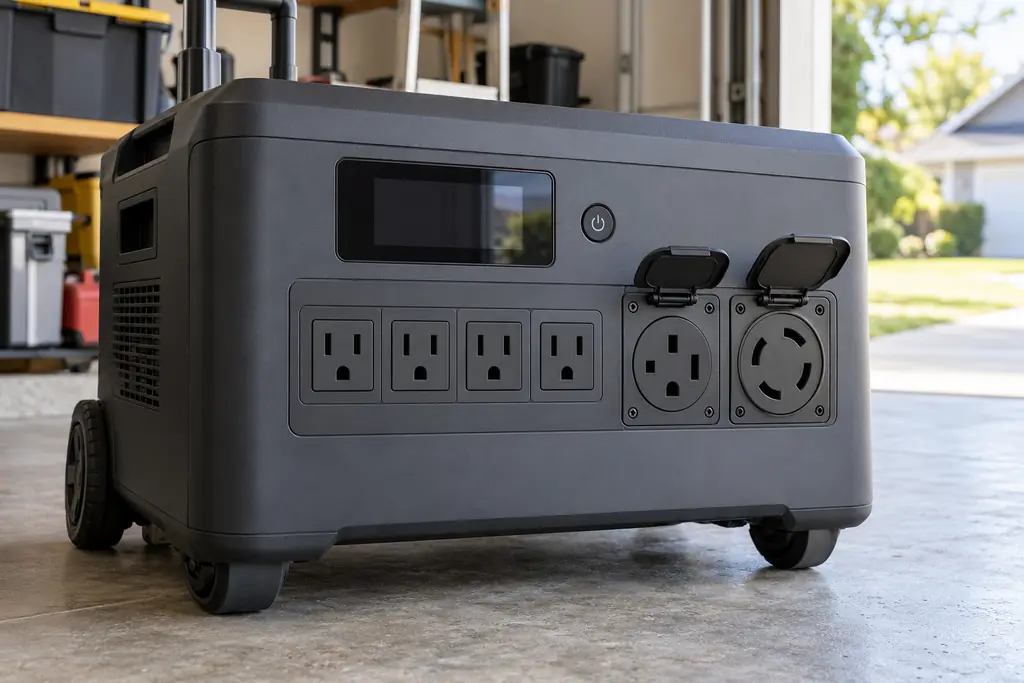
Both systems provide 120/240V AC output, which matters if your home has equipment that needs 240V. The DELTA Pro 3 lists seven AC outlets, including TT-30R, L14-30R and NEMA 6-20R receptacles. The F3800 Plus lists eight, including TT-30R and L14-30R.
Each outlet type serves different electrical requirements, and having the right connector doesn't make every appliance at that nominal voltage compatible. Check the outlet rating against the appliance's requirements and the manufacturer's instructions.
Household circuits require professional installation
Neither power station should be connected to household wiring without approved transfer equipment, and you should never backfeed a home. Supplying household circuits takes listed transfer equipment, such as a transfer switch or an interlock kit with an inlet, installed by a licensed electrician with any required permit.
NEC Article 702 covers optional standby systems and requires transfer equipment designed and installed to prevent inadvertent interconnection of normal utility and alternate sources. Your area may use an older NEC edition. Read our transfer switch guide before you choose home connection accessories.
Expansion for longer outages
Expansion is one of the biggest differences here. In our verified product data the DELTA Pro 3 expands to 12,000Wh and the F3800 Plus to 26,880Wh. Those are the manufacturers' supported configurations, not what comes in the box, so you have to add compatible expansion batteries to reach them. More batteries add stored energy, but they don't raise the inverter's continuous output or change its voltage capability.
Before deciding how far to expand, estimate what your essential appliances will use during an outage:
Required energy (Wh) = Average load (W) × Operating hours
Then apply the 80% to 90% AC energy assumption. Even a large expanded system will need recharging if the outage runs longer than its stored energy can cover.
Solar charging differences
The F3800 Plus accepts up to 3,200W of solar input. The DELTA Pro 3 accepts up to 2,600W across two inputs, and the input voltage ranges differ too:
| Model | Solar input voltage |
|---|---|
| DELTA Pro 3, high-voltage input | 30 to 150V |
| DELTA Pro 3, low-voltage input | 11 to 60V |
| F3800 Plus | 11 to 165V |
Those ranges decide which panels you can use. An array has to stay within the manufacturer's voltage, current and power input limits, so don't pick panels on wattage alone.
Solar input is not solar production
A higher maximum input rating doesn't mean the F3800 Plus will collect more energy in every location or every kind of weather. Production depends on sunlight, the panels you connect and operating conditions, and the input rating is a system limit, not a daily forecast. For an extended outage, compare what your appliances use against a realistic charging plan.
Wall charging and recharging time
The F3800 Plus lists 1,800W of wall charging input. Our verified comparison data doesn't state the DELTA Pro 3's maximum AC charging wattage, and neither model has a fastest full AC charging time stated under clearly comparable conditions, so we can't name a wall charging winner. A maximum input wattage isn't a verified full charging time either. Check each model's charging specifications against the power source you plan to use.
If you plan to recharge from a generator, check that its output is compatible with the power station's input. CDC guidance says fuel generators must stay outdoors, at least 20 feet from doors, windows and vents. Never run a fuel generator indoors.
Weight and portability
The DELTA Pro 3 weighs 113.5 lb and the F3800 Plus weighs 135.6 lb, so EcoFlow is 22.1 lb lighter. That difference matters if you expect to move the system between locations, but both are heavy home-backup units, not batteries you'd carry around often. Plan where the system will be stored and run, and follow the manufacturer's placement, ventilation and charging instructions.
UPS behavior is not identical
The DELTA Pro 3 lists a 10ms UPS switchover. The F3800 Plus lists 20ms, but only for its three leftmost NEMA 5-20R outlets when running on wall power under the specified conditions, so don't apply that figure to all eight outlets. Both are manufacturer claims, and neither guarantees uninterrupted operation for every connected appliance. For a CPAP or other essential medical equipment, confirm compatibility and backup requirements with the device manufacturer or your equipment provider.
Battery cycle life and warranty
Both models use LFP batteries. The DELTA Pro 3 claims 4,000 cycles to 80% remaining capacity. The F3800 Plus lists 3,000 cycles, but our verified data doesn't state the remaining-capacity percentage, so the two claims can't support a full service-life comparison.
The warranty terms also differ:
- EcoFlow DELTA Pro 3: three years, plus two more years with registration in the EcoFlow app.
- Anker SOLIX F3800 Plus: five years.
Read each manufacturer's warranty terms rather than assuming the stated period covers every circumstance.
Our call
Someone planning for 240 V loads with a higher continuous demand should examine F3800 Plus, keeping its charging restriction in mind. It has eight AC outlets versus seven on DELTA Pro 3, while its 20 ms UPS figure applies to three outlets on wall power only.
DELTA Pro 3 fits buyers prioritizing its stored capacity and stated surge rating, along with a 10 ms UPS figure. For a 60 W fridge, our calculation gives 54.6 to 61.4 hours on DELTA Pro 3 and 51.2 to 57.6 hours on F3800 Plus, assuming 80% to 90% of rated capacity reaches AC appliances.
Questions readers ask
Which is better for whole-house backup, DELTA Pro 3 or F3800 Plus?
The F3800 Plus has higher continuous output and a larger expansion limit. The DELTA Pro 3 has more built-in energy, lower weight and a published surge rating. The right choice depends on the appliances and circuits you want to support.
Can both power 240V appliances?
Both provide 120/240V output and list compatible receptacle types, but you still need to check each appliance's running and startup requirements. Supplying household circuits requires listed transfer equipment installed by a licensed electrician with any required permit.
Which has more battery capacity?
The DELTA Pro 3 has 4,096Wh built in, compared with 3,840Wh for the F3800 Plus. With compatible expansion batteries, the F3800 Plus supports 26,880Wh versus 12,000Wh for the DELTA Pro 3.
Which supports faster solar charging?
The F3800 Plus accepts up to 3,200W solar input, compared with 2,600W across two inputs on the DELTA Pro 3. These are manufacturer input limits, not measured charging speeds or daily solar production.