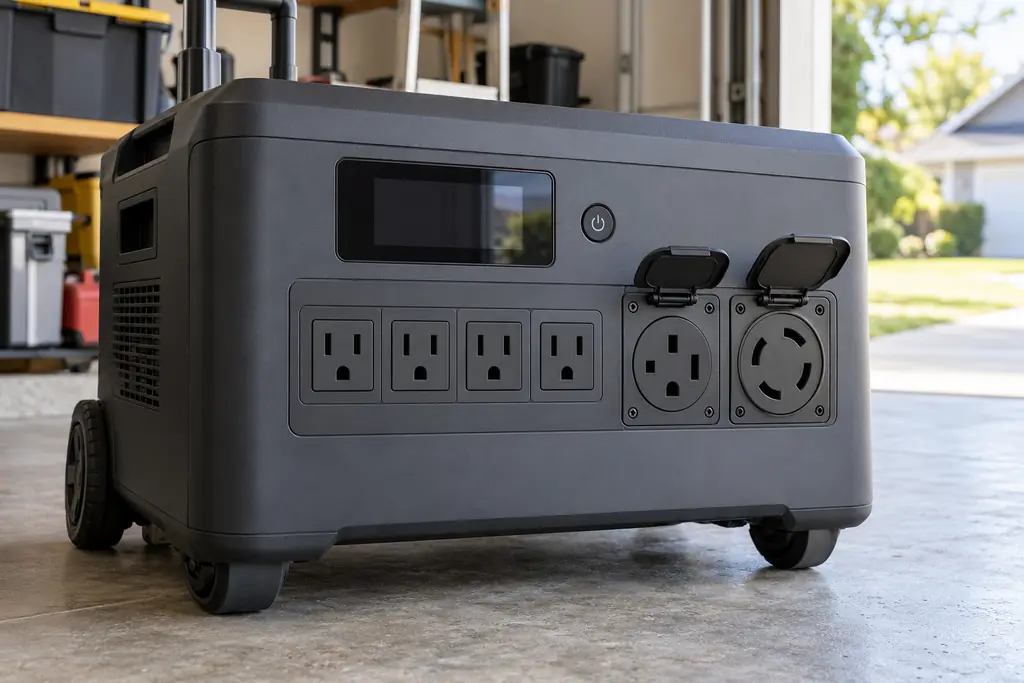
Which one to choose
The Jackery HomePower 3600 Plus and Anker SOLIX F3800 Plus are both LFP stations intended for substantial backup loads. Their main difference is not battery capacity. It is how they deliver 240 V power, how much continuous output they provide and how far they can expand.
Choose the HomePower 3600 Plus if
You mainly need 120 V backup, want a lighter station and do not need 240 V from one unit.
The HomePower 3600 Plus provides 3,600 W continuous output, 3,584 Wh of storage and five AC outlets. Its 77.16 lb weight makes it substantially lighter than the F3800 Plus.
Jackery also supports expansion to a stated 21 kWh using up to five Battery Pack 3600 units. If 240 V becomes necessary, two HomePower units support parallel operation. That requires a second main unit, not just an expansion battery.
Choose the F3800 Plus if
You need 120/240 V and 6,000 W continuous output from one station.
The Anker SOLIX F3800 Plus provides both voltages through its L14-30R outlet. That makes it the simpler choice when a 240 V load such as a well pump is on your list, subject to the appliance's starting requirements.
It also provides 3,840 Wh before expansion, supports up to 26,880 Wh with expansion batteries and accepts up to 3,200 W of solar input.
The trade-off is weight: 135.6 lb according to Anker's manual.
| Decision point | HomePower 3600 Plus | F3800 Plus |
|---|---|---|
| 240 V capability | Two main units in parallel | One unit |
| Continuous output, one unit | 3,600 W at 120 V | 6,000 W at 120/240 V |
| Base capacity | 3,584 Wh | 3,840 Wh |
| Maximum stated expansion | 21 kWh | 26,880 Wh |
| Maximum solar input | 1,000 W | 3,200 W |
| UPS switchover | 10 ms | 20 ms, selected outlets |
| AC outlets | 5 | 8 |
| Weight | 77.16 lb | 135.6 lb |
120 V vs 240 V
This is the main reason to choose one over the other.
A single HomePower 3600 Plus is a 120 V only station. Its manual states that two units operating in parallel can provide 240 V through the AC Expansion Port, rated at 30 A and 7,200 W maximum.
The F3800 Plus provides 120/240 V through its NEMA L14-30R outlet from a single unit, rated at 25 A and 6,000 W maximum. However, Anker states that 240 V output cannot be used while charging through 120 V AC.
For a 240 V well pump, running watts do not tell the whole story. The reference figures are:
- 1/2 HP pump: 655 to 960 W while running, with 5,290 to 7,406 VA at locked rotor.
- 1 HP pump: 1,160 to 1,600 W while running, with 9,614 to 11,201 VA at locked rotor.
Locked-rotor VA describes apparent power at startup, not running watts. These figures cannot simply be compared with a station's continuous watt rating.
A surge rating for the F3800 Plus is not stated by Anker. Jackery lists 7,200 W surge, but that figure is for one 120 V unit, not a stated two-unit 240 V surge rating.
Neither specification alone confirms whether a particular pump will start. Ask the pump manufacturer for its starting requirements and see the well pump guide.
Supplying household circuits needs listed transfer equipment, either a transfer switch or an interlock kit with an inlet, installed by a licensed electrician with any required permit. Our transfer switch guide covers the equipment options.
Runtime and expansion
These runtimes are our calculation, not physical measurements of these stations. They assume 80% to 90% of rated capacity reaches AC appliances.
At base capacity:
- Refrigerator averaging 60 W: Jackery provides 47.8 to 53.8 hours; Anker provides 51.2 to 57.6 hours.
- Refrigerator plus chest freezer averaging 84 W: Jackery provides 34.1 to 38.4 hours; Anker provides 36.6 to 41.1 hours.
- CPAP with heated humidifier at 56.1 W: Jackery provides 6.4 to 7.2 eight-hour nights; Anker provides 6.8 to 7.7 nights.
- Router plus modem at up to 16.4 W: Jackery provides 174.8 to 196.7 hours; Anker provides 187.3 to 210.7 hours.
- Gas furnace blower at 282 W: Jackery provides 10.2 to 11.4 hours; Anker provides 10.9 to 12.3 hours of blower running time.
- Essentials using up to 2,124 Wh per day: Jackery covers 1.35 to 1.52 days; Anker covers 1.45 to 1.63 days.
For a 240 V pump drawing 960 W while running, our calculation gives the F3800 Plus 3.2 to 3.6 hours of pumping time. That does not establish startup compatibility.
Expansion makes a larger difference than the small gap in base capacity.
Jackery's stated 21 kWh, using up to five Battery Pack 3600 units, gives 200.0 to 225.0 hours for the 84 W refrigerator and freezer load. An essentials day using up to 2,124 Wh extends to 7.91 to 8.90 days.
Anker supports six BP3800 expansion batteries, reaching 26,880 Wh. At that capacity, the same refrigerator and freezer load gives 256.0 to 288.0 hours, while the essentials day gives 10.12 to 11.39 days.
These expanded figures use the same 80% to 90% AC assumption. Use your own appliance figures in the runtime calculator.
Charging
Wall charging
Anker specifies up to 1,800 W when charging from a 120 V wall outlet. A complete AC charging time is not stated by Anker.
Jackery lists 100 to 120 V AC input at 15 A maximum, but charging wattage is not stated by Jackery. Its advertised 2-hour charge requires combined AC and DC input, so it should not be treated as a wall-only time.
Generator charging
Anker specifies charging from a 240 V generator using its Generator Input Adapter, with up to 3,300 W for one station or up to 6,000 W with expansion batteries. A separate generator charging rate is not stated by Jackery.
If using a fuel generator, the CDC says to keep it outside, at least 20 feet from doors, windows and vents.
Solar charging
Anker supports up to 3,200 W across two solar inputs, each rated to 1,600 W. Its manual specifies 11 to 165 V and up to 17 A per input.
Jackery supports up to 1,000 W through two DC8020 inputs, with 12 to 60 V working voltage ranges and up to 24 A total. Its manual separately specifies panel open-circuit voltage within 16 to 60 V.
Anker has the higher stated solar input ceiling. Actual charging depends on a compatible panel configuration and available sunlight.
Outlets and UPS
Jackery provides four 120 V AC outlets rated at 20 A maximum and one NEMA TT-30 outlet rated at 30 A. The exact type of its four household outlets is not stated by Jackery.
Anker has six NEMA 5-20R outlets divided into two groups of three, with each group limited to 2,400 W. Its TT-30R is rated to 3,000 W, and its L14-30R to 6,000 W.
Jackery specifies a 10 ms UPS switchover and states that it does not support 0 ms switching.
Anker specifies 20 ms switching when connected to a 120 V wall outlet, and that UPS function applies only to the left three NEMA 5-20R outlets. Do not assume all eight outlets provide UPS operation.
These switching intervals matter for equipment that cannot tolerate a brief interruption.
Weight and where it lives
At 77.16 lb, Jackery is 58.44 lb lighter than Anker's manual-listed 135.6 lb. Anker's specification page gives a conflicting 136.7 lb, so this comparison uses its manual figure.
Consider where the station will remain during an outage and whether you need to move it for charging or access to outlets.
Both have 5-year warranty coverage, although Jackery's consists of 3 years standard plus 2 years after registration.
Their cycle claims also differ. Jackery specifies 6,000 cycles to over 70% capacity. Anker claims more than 3,000 cycles, but its retention threshold is not stated by Anker. Those claims should not be treated as equivalent durability measurements.
Our call
Choose the F3800 Plus if you need 120/240 V and 6,000 W continuous output from one unit, or want the larger stated solar and battery expansion limits. For a 240 V well pump, get the manufacturer's startup requirements before making the choice.
Choose the HomePower 3600 Plus if your loads are primarily 120 V, its 3,600 W output is sufficient and lower weight matters. Its expansion capacity also makes it worth considering for longer outages, provided you do not need single-unit 240 V output.
Neither base battery is sized to run every household load continuously through a long outage. The practical decision is which essential loads you need, their starting requirements and how much stored energy you plan to add.
See the whole-house backup guide for broader planning, or the DELTA Pro 3 vs F3800 Plus comparison for another large-station comparison.
Questions readers ask
Does the Jackery HomePower 3600 Plus provide 240 V power?
A single HomePower 3600 Plus supplies 120 V only. Two units connected in parallel provide 240 V through the AC Expansion Port, rated at 30 A and 7,200 W maximum during parallel operation. The Anker SOLIX F3800 Plus provides 120/240 V through its L14-30R outlet from one unit, rated at 25 A and 6,000 W maximum.
Can the Anker F3800 Plus run a 240 V well pump?
The F3800 Plus supplies 240 V and 6,000 W continuous output, but pump startup demand must be checked separately. Reference figures show a 1/2 HP pump needing 5,290 to 7,406 VA at locked rotor and a 1 HP pump needing 9,614 to 11,201 VA. These are VA figures, not watts. Anker does not state a surge rating for the F3800 Plus. Confirm the pump's starting requirements with its manufacturer before deciding.
How long can these stations run a refrigerator and chest freezer?
For a refrigerator and chest freezer averaging 84 W together, our calculation gives the HomePower 3600 Plus 34.1 to 38.4 hours and the F3800 Plus 36.6 to 41.1 hours. At their stated expanded capacities, those figures become 200.0 to 225.0 hours for Jackery and 256.0 to 288.0 hours for Anker. All estimates assume 80% to 90% of rated capacity reaches AC appliances.
What is needed to supply household circuits?
Supplying household circuits needs listed transfer equipment, either a transfer switch or an interlock kit with an inlet, installed by a licensed electrician with any required permit. See the transfer switch guide for the equipment options.