How to choose
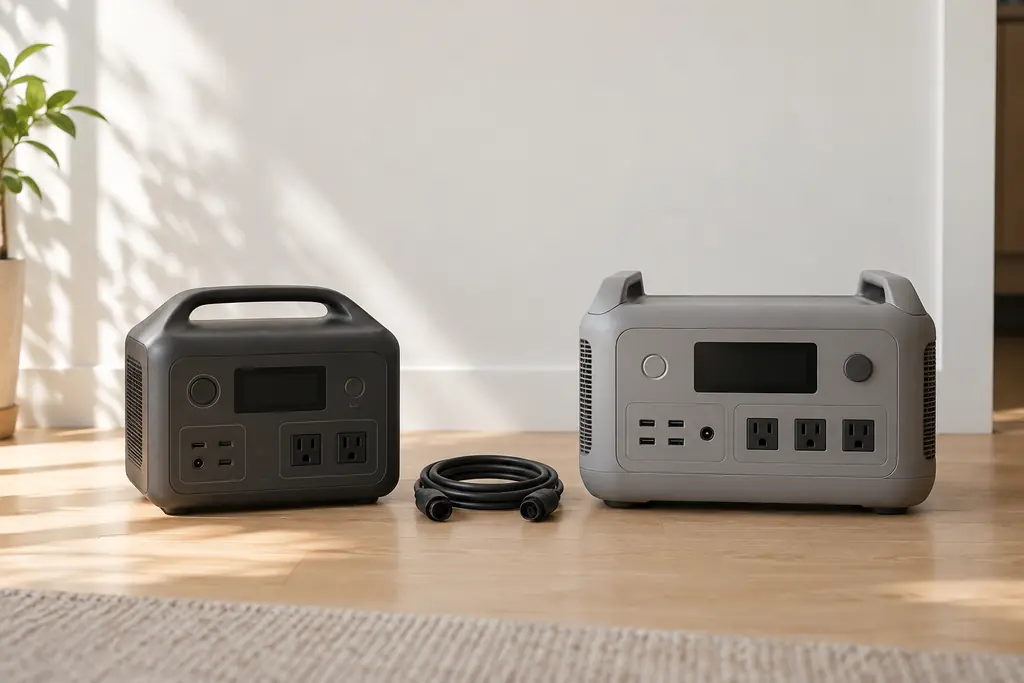
For the 1 kWh pair, DELTA 3 Plus accepts 1,000 W solar versus 400 W on Explorer 1000 v2. Explorer 1000 v2 is lighter at 23.8 lb versus 27.6 lb. For the larger pair, the older DELTA 2 Max supports 2,400 W continuous versus 2,200 W on Explorer 2000 v2. DELTA 2 Max also expands to 6,144 Wh, while expansion is not stated by Jackery for Explorer 2000 v2.
Explorer 1000 v2 vs DELTA 3 Plus
The Jackery Explorer 1000 v2 stores 1,070Wh and the EcoFlow DELTA 3 Plus stores 1,024Wh, a small difference for planning appliance runtime. For a refrigerator averaging 60W, using our 80% to 90% AC energy assumption:
- Explorer 1000 v2: 14.3 to 16.1 hours
- DELTA 3 Plus: 13.7 to 15.4 hours
These are calculations, not physical measurements. Neither estimate confirms that the power station can start a particular refrigerator, so check the compressor's startup requirements separately.
Output and outlets
The DELTA 3 Plus provides 1,800W continuous and 3,600W surge, against 1,500W continuous and 3,000W surge for the Explorer 1000 v2. It also has six AC outlets instead of three, which helps when you're running several compatible appliances together.
EcoFlow advertises X-Boost at 2,200W, and Jackery doesn't state an equivalent boost specification in our verified data. X-Boost is a separate operating feature, not extra unrestricted continuous output.
Weight and charging
The Explorer 1000 v2 weighs 23.8 lb and the DELTA 3 Plus 27.6 lb, so Jackery has the edge if you move your battery often. EcoFlow answers with up to 1,000W of solar input and expansion to approximately 5kWh. The Jackery accepts up to 400W of solar input, and its expansion compatibility isn't stated.
For wall charging, Jackery advertises a 60-minute full charge in Emergency Charging mode, which you enable through the app, against 56 minutes for the DELTA 3 Plus. Jackery's standard charging time is 1.58 hours, so don't treat the emergency mode as its normal setting when you compare.
Explorer 2000 v2 vs DELTA 2 Max
The larger pair also has nearly identical rated capacities: 2,042Wh for the Jackery Explorer 2000 v2 and 2,048Wh for the EcoFlow DELTA 2 Max. For a refrigerator averaging 60W:
- Explorer 2000 v2: 27.2 to 30.6 hours
- DELTA 2 Max: 27.3 to 30.7 hours
Under the same assumptions the runtime difference is minimal, so choose on the other specifications.
Output and expansion
The DELTA 2 Max offers 2,400W continuous and 4,800W surge, plus a stated 3,400W X-Boost mode. The Explorer 2000 v2 offers 2,200W continuous and 4,400W surge. The DELTA 2 Max also has six AC outlets to the Jackery's three.
EcoFlow supports expansion to 6,144Wh, while our verified sources don't state expansion for the Explorer 2000 v2. If you're planning for longer outages, that documented expansion option is a reason to look at the DELTA 2 Max.
Portability and solar
The Explorer 2000 v2 weighs 39.5 lb and the DELTA 2 Max 50 lb, making the Jackery 10.5 lb lighter on the published figures. For solar charging, EcoFlow accepts up to 1,000W of input against Jackery's 400W. That's an input limit, not a daily production figure: panel compatibility and sunlight still decide how much energy you collect.
Battery cycle-life claims
All four models use LFP batteries, but their cycle-life claims use different remaining-capacity thresholds. The Jackery models specify 4,000 cycles to 70% remaining capacity, the DELTA 3 Plus 4,000 cycles to 80%, and the DELTA 2 Max 3,000 cycles to 80%. Because the thresholds differ, a higher cycle count doesn't establish a longer useful battery life under identical conditions, and none of these are independently measured results.
Warranty and UPS differences
Both EcoFlow models list five-year warranties. Both Jackery models list three years plus two more with registration. For backup switchover:
- Explorer 1000 v2: Under 20ms
- DELTA 3 Plus: 10ms
- Explorer 2000 v2: Under 20ms
- DELTA 2 Max: 30ms in its manual
EcoFlow's updated DELTA 2 Max product page states 20ms, which differs from the 30ms in the manual. We keep the manual figure in our comparison and flag the difference. All of these are manufacturer-stated times and don't guarantee uninterrupted operation for every connected appliance or medical device.
Our call
Carrying a station up stairs points toward Explorer 1000 v2, while DELTA 3 Plus suits a setup with more appliances plugged in at once. DELTA 3 Plus has six AC outlets and under 10 ms UPS versus three outlets and 20 ms on the Explorer.
Adding batteries later points toward the older DELTA 2 Max, which has a stated expansion path. Explorer 2000 v2 is the alternative when its 20 ms UPS figure matters more than expansion, compared with 30 ms in the DELTA 2 Max manual.
Questions readers ask
Is Jackery or EcoFlow better for home backup?
In these matched pairs, EcoFlow has higher continuous output, more AC outlets and more maximum solar input. Jackery has lower weight and a shorter stated UPS switchover in the larger pair. Neither brand is the right choice for every household.
Which is lighter, Jackery or EcoFlow?
The Explorer 1000 v2 weighs 23.8 lb versus 27.6 lb for the DELTA 3 Plus. The Explorer 2000 v2 weighs 39.5 lb versus 50 lb for the DELTA 2 Max.
Which charges faster from solar?
The DELTA 3 Plus and DELTA 2 Max each accept up to 1,000W of solar input, compared with 400W for both Jackery models. Actual charging speed depends on compatible panels and operating conditions.
Which has a longer battery life?
Both Jackery models claim 4,000 cycles to 70% remaining capacity. The DELTA 3 Plus claims 4,000 cycles to 80%, and the DELTA 2 Max claims 3,000 cycles to 80%. These claims use different endpoints, so don't treat them as directly equivalent.