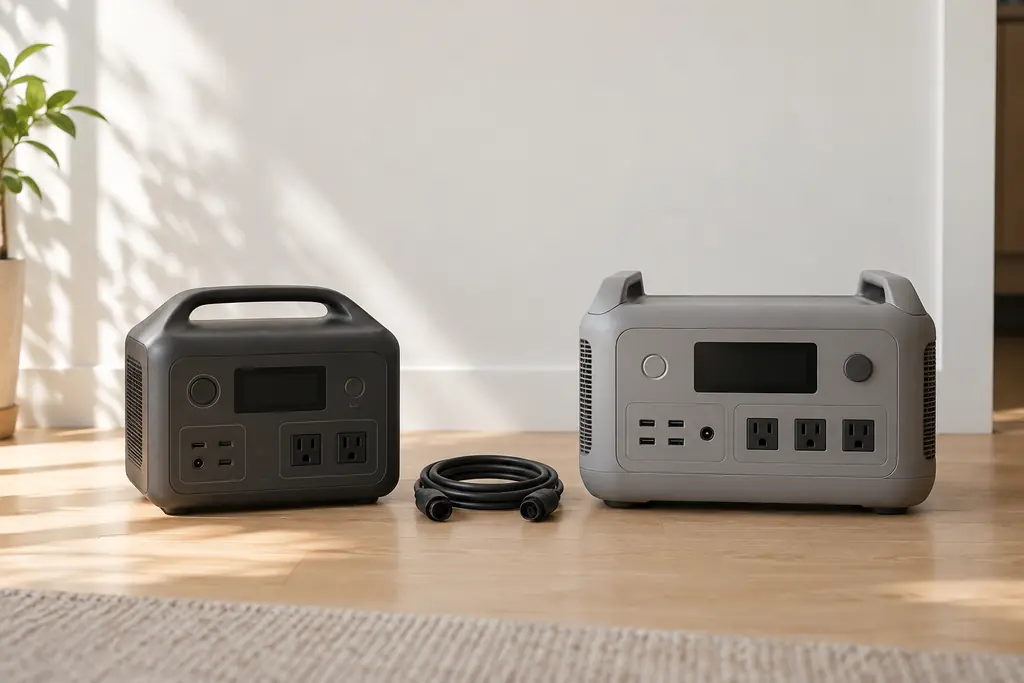
Which one to choose
These stations have similar capacities but serve different needs. Compare running wattage, recharging and possible expansion. All three supply 120 V AC.
Choose the DJI Power 1000 V2 if
You need greater continuous output or longer backup through expansion. DJI supplies 2,600 W continuously and has four US AC outlets. With separately purchased expansion batteries, capacity can reach 11,264 Wh. At 31.3 lb, it is the heaviest here.
Choose the C1000 Gen 2 if
You want 2,000 W continuous output at 24.9 lb and do not need expansion. Anker accepts up to 600 W of solar input. Its claimed 49-minute full charge requires app-enabled UltraFast mode and a battery above 68°F.
Choose the Explorer 1000 v2 if
You want the lightest unit here, at 23.8 lb, and can stay within 1,500 W continuous output. Jackery has 1,070 Wh, compared with 1,024 Wh in either rival. Its manual states 3,000 W surge. Its 5-year warranty consists of 3 years standard plus 2 years with registration.
| Decision point | DJI | C1000 Gen 2 | Explorer 1000 v2 |
|---|---|---|---|
| Continuous output | 2,600 W | 2,000 W | 1,500 W |
| Carry weight | 31.3 lb | 24.9 lb | 23.8 lb |
| US AC outlets | 4 | Not stated by Anker | 3 |
| Fastest claimed full charge | 56 minutes | 49 minutes | 60 minutes |
| Solar ceiling | Up to 1,800 W with extra equipment | 600 W | 400 W |
| Expansion | Up to 11,264 Wh | Not expandable | Not stated by Jackery |
| UPS switchover | 10 ms | 10 ms | 20 ms |
Runtime in an outage
These figures are our calculation, not station test results. They assume 80% to 90% of rated capacity reaches AC appliances. DJI and Anker have identical estimates; Jackery runs slightly longer.
- Refrigerator averaging 60 W: DJI and Anker each provide 13.7 to 15.4 hours; Jackery provides 14.3 to 16.1 hours.
- Refrigerator plus chest freezer, averaging 84 W together: DJI and Anker each provide 9.8 to 11.0 hours; Jackery provides 10.2 to 11.5 hours.
- CPAP with heated humidifier at 56.1 W: DJI and Anker each provide 1.8 to 2.1 eight-hour nights. Jackery provides 1.9 to 2.1 nights.
- Router plus modem drawing up to 16.4 W: DJI and Anker each provide 50.0 to 56.2 hours; Jackery provides 52.2 to 58.7 hours.
- Gas furnace blower at 282 W while running: DJI and Anker each provide 2.9 to 3.3 hours of blower running time; Jackery provides 3.0 to 3.4 hours.
Blower runtime counts only time running; startup demand also matters. Use your own appliance figures in the runtime calculator. See the refrigerator and CPAP guides for those loads.
Charging and its conditions
Anker claims a 49-minute full charge. Its 1,600 W UltraFast mode must be enabled in the app and works only when the battery is above 68°F. Standard AC charging is up to 1,200 W.
DJI claims a 56-minute full charge and 0% to 80% in 37 minutes from grid power in its own lab test at 25 C. Its wall input figures conflict. The manual gives approximately 1,800 W with Super Recharging enabled in the DJI Home app, while a product page footnote gives a 1,440 W maximum grid charging power. The US input specification also lists 100 to 120 V and 13 A maximum. Do not treat the manual's 1,800 W as an unconditional US wall charging figure.
Jackery claims a 60-minute full charge using Emergency Charging Mode in its app. Its standard charging time is 1.58 hours. Wall charging wattage is not stated by Jackery; its AC input listing provides voltage and current, not a charging wattage.
Solar creates another decision. Anker has one XT60i input rated up to 600 W, with a manual range of 11 to 60 V and current limits that change across the voltage ranges. Jackery supports up to 400 W using two DC8020 inputs.
DJI advertises up to 1,800 W, but only with its separate 1.8kW Solar/Car Super Fast Charger, XT90 to MC4 cable and DJI Power Expansion Battery 2000. The charger alone supports up to 1,200 W through its MC4 cable; DJI's Solar Panel Adapter Module is rated to 400 W. Without those separately sold parts, the 1,800 W figure does not apply.
Surge and output
For steady loads, DJI's 2,600 W continuous rating leaves more room than Anker's 2,000 W or Jackery's 1,500 W. That does not establish whether a particular refrigerator compressor or furnace blower will start. Check the appliance's startup demand as well as its running wattage.
Surge output is not stated by DJI for the Power 1000 V2. Anker's product page says 3,000 W peak, but its manual does not give a peak figure. Separately, Anker describes SurgePad operation up to 2,400 W, which is not available in bypass mode. Jackery's manual specifies 3,000 W surge. Do not read any of these numbers as a guarantee for a particular motor.
Their UPS switching figures also differ: DJI and Anker state 10 ms, while Jackery states 20 ms. DJI and Jackery say they do not provide 0 ms switching. See power station vs UPS if uninterrupted operation matters to your equipment.
Expansion
Only DJI documents a way to add capacity. With five DJI Power Expansion Battery 2000 units, the total reaches 11,264 Wh. At that expanded capacity, our calculation gives 150.2 to 169.0 hours for a 60 W refrigerator, or 107.3 to 120.7 hours for a refrigerator and chest freezer averaging 84 W together, under the same 80% to 90% AC assumption.
Anker says the C1000 Gen 2 is not expandable. Expansion support is not stated by Jackery for the Explorer 1000 v2. If you only plan to carry and recharge one station, DJI's expansion advantage may not matter.
Our call
Choose DJI when continuous output and a documented expansion path are the deciding factors, and its higher weight is acceptable. Choose Anker when 2,000 W output, lower weight and its conditional fast charging are a closer fit. Choose Jackery when the lightest weight here matters more than the lower continuous output, and its small capacity advantage is useful.
For a refrigerator, CPAP or router, the runtime difference between these batteries is small. For a furnace blower, confirm startup demand before deciding from the running watts alone. Read the DJI Power 1000 V2, Anker SOLIX C1000 Gen 2 and Jackery Explorer 1000 v2 model pages for each station's listed details.
Questions readers ask
Can these power stations run a refrigerator during an outage?
Yes, for a refrigerator within their output limits. Our calculation for a refrigerator averaging 60 W gives the DJI Power 1000 V2 and Anker SOLIX C1000 Gen 2 each 13.7 to 15.4 hours. The Jackery Explorer 1000 v2 gives 14.3 to 16.1 hours. These estimates assume 80% to 90% of rated capacity reaches AC appliances. Refrigerator startup demand must also fit the station's output capabilities.
Which has the highest continuous AC output?
The DJI Power 1000 V2 has 2,600 W continuous AC output, followed by the Anker SOLIX C1000 Gen 2 at 2,000 W and the Jackery Explorer 1000 v2 at 1,500 W. All three supply 120 V AC. Their continuous ratings do not establish whether a particular motor will start.
Can all three power stations use expansion batteries?
No. The DJI Power 1000 V2 supports up to five DJI Power Expansion Battery 2000 units, reaching 11,264 Wh total capacity. Anker says the C1000 Gen 2 is not expandable. Expansion support is not stated by Jackery for the Explorer 1000 v2.
How quickly do these stations switch to battery power?
DJI lists 10 ms UPS switchover for the Power 1000 V2, and Anker lists 10 ms for the C1000 Gen 2. Jackery lists 20 ms for the Explorer 1000 v2. DJI and Jackery state that their units do not support 0 ms switching. Check whether your equipment can tolerate the interruption.