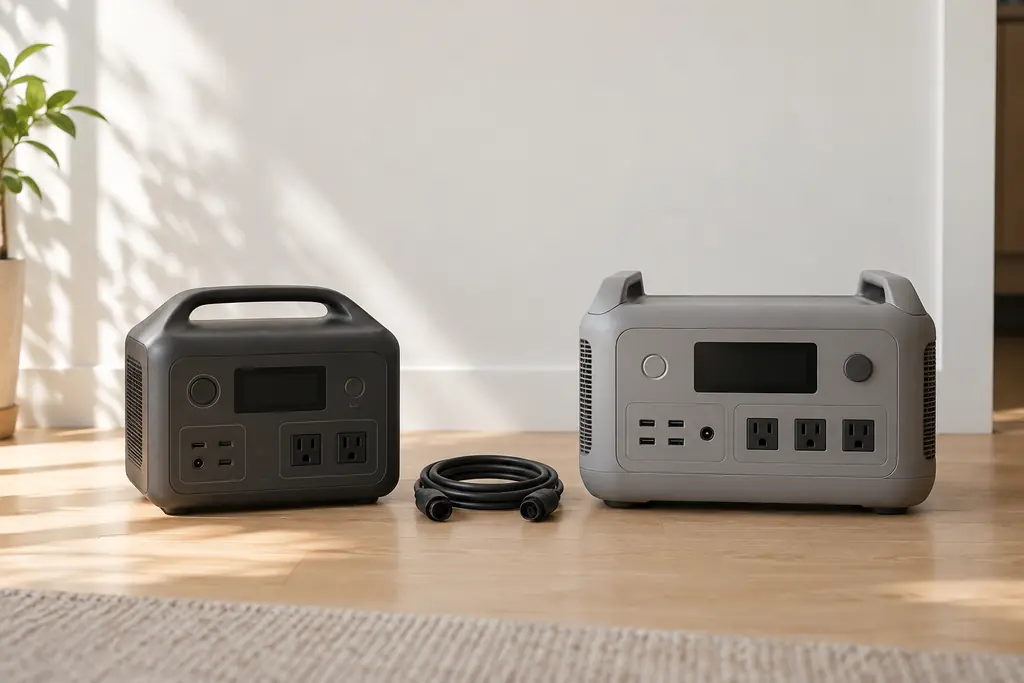
Which one to choose
The VTOMAN FlashSpeed 2400 and VTOMAN Jump 1800 both have 1,408 Wh LiFePO4 batteries in their current listings. Their base-unit runtimes are therefore identical in our calculations.
The main choice is between FlashSpeed's higher continuous output, faster charging and UPS function, and Jump's battery expansion. Their V-Beyond ratings need separate attention because those figures do not represent normal full-voltage continuous output.
Choose the FlashSpeed 2400 if
Choose FlashSpeed 2400 if you need 2,400 W continuous AC output, 1,500 W wall charging or a stated 10 ms UPS transfer time. VTOMAN lists a full charge in 60 minutes using its 1,500 W AC input.
FlashSpeed also accepts up to 600 W solar input through an Anderson connection. Its 3 AC outlets provide 120 V pure sine wave output.
VTOMAN states a 3,200 W peak rating and V-Beyond operation up to 3,200 W for resistive loads. Do not treat that figure as continuous full-voltage output for electronics or motor-driven equipment.
Battery expansion is not stated for FlashSpeed 2400. VTOMAN's extra battery listings name other models rather than this station.
Choose the Jump 1800 if
Choose Jump 1800 if you want to increase capacity using a separately sold battery. VTOMAN lists expansion from 1,408 Wh to 2,956 Wh with the 1,548 Wh Jump 1500 Extra Battery.
Its continuous output is 1,800 W. VTOMAN lists a 3,600 W peak rating and V-Beyond up to 3,600 W, but the manual limits V-Beyond to resistive loads and explains that it reduces voltage.
Jump uses an external 330 W charging adapter. The manual gives about 4 hours for charging, although that manual describes the 1,548 Wh capacity version.
VTOMAN explicitly says Jump 1800 cannot operate as a UPS because its outputs must be switched on manually.
| Decision point | VTOMAN FlashSpeed 2400 | VTOMAN Jump 1800 |
|---|---|---|
| Current battery capacity | 1,408 Wh LFP | 1,408 Wh LFP; 2023 manual says 1,548 Wh |
| Battery cycle rating | 3,000 cycles to 80% | 3,000 cycles to 80% |
| Continuous AC output | 2,400 W | 1,800 W |
| Peak and V-Beyond | 3,200 W; V-Beyond for resistive loads | 3,600 W; V-Beyond for resistive loads |
| Wall charging | 1,500 W, 60 minutes to full | External 330 W adapter, about 4 hours in the 1,548 Wh manual |
| Solar input | 600 W, 12 to 60 V | 400 W total DC input, 12 to 60 V; headline says 220 W solar |
| Expansion | Not stated | 2,956 Wh with Jump 1500 Extra Battery |
| UPS and weight | 10 ms, 41.9 lb | No UPS, 38.5 lb |
Quick verdict
| If you need | Pick |
|---|---|
| 2,400 W continuous AC output rather than 1,800 W | VTOMAN FlashSpeed 2400 |
| A full charge in 60 minutes using 1,500 W AC input | VTOMAN FlashSpeed 2400 |
| A stated 10 ms UPS transfer function | VTOMAN FlashSpeed 2400 |
| Expansion from 1,408 Wh to 2,956 Wh with an extra battery | VTOMAN Jump 1800 |
| A lighter unit at 38.5 lb instead of 41.9 lb | VTOMAN Jump 1800 |
Runtime in an outage
Both current base models have 1,408 Wh capacity. Our calculations assume 80% to 90% of rated battery capacity reaches AC appliances. Actual runtimes depend on the load and operating conditions.
For the FlashSpeed 2400:
- Refrigerator averaging 60 W: 18.8 to 21.1 hours.
- Refrigerator plus chest freezer averaging 84 W together: 13.4 to 15.1 hours.
- Wi-Fi router plus modem at 16.4 W: 68.7 to 77.3 hours.
- Gas furnace blower at 282 W while running: 4.0 to 4.5 hours.
- CPAP with heated humidifier at 56.1 W, using 8-hour nights: 2.5 to 2.8 nights. Confirm with the device maker and your doctor before relying on a power station.
For the Jump 1800:
- Refrigerator averaging 60 W: 18.8 to 21.1 hours.
- Refrigerator plus chest freezer averaging 84 W together: 13.4 to 15.1 hours.
- Wi-Fi router plus modem at 16.4 W: 68.7 to 77.3 hours.
- Gas furnace blower at 282 W while running: 4.0 to 4.5 hours.
- CPAP with heated humidifier at 56.1 W, using 8-hour nights: 2.5 to 2.8 nights. Confirm with the device maker and your doctor before relying on a power station.
Jump's stated expanded capacity of 2,956 Wh changes the calculation. With the Jump 1500 Extra Battery connected, our calculation estimates:
- Refrigerator averaging 60 W: 39.4 to 44.3 hours.
- Refrigerator plus chest freezer averaging 84 W together: 28.2 to 31.7 hours.
These expanded runtimes require the separately sold battery and do not apply to the base Jump 1800.
Use the runtime calculator to estimate other loads. Battery capacity determines the energy available, while output rating and start-up demand determine whether an appliance can run.
Charging and solar
FlashSpeed 2400 has the stronger stated wall-charging specification. VTOMAN lists 1,500 W AC input and a full charge from empty in 60 minutes.
Jump 1800 uses an included external 330 W adapter connected through its DC input. Its manual states approximately 4 hours from a wall charger, but the manual was written for the 1,548 Wh version. VTOMAN does not give a separate full-charge time for the currently listed 1,408 Wh version.
For solar, FlashSpeed accepts up to 600 W through an Anderson input rated at 12 to 60 V. Connecting MC4 panels requires an adapter cable. VTOMAN also lists a separate 12 to 20 V, 200 W DC input, but does not describe that connection as another solar input.
Jump's solar information needs careful reading. Its product headline says 220 W solar, while the specification table and manual describe 400 W maximum total DC input at 12 to 60 V through two DC5521 connections. MC4 panels require an adapter cable.
VTOMAN does not state a maximum solar input current for either model. Check the electrical requirements and connector type before choosing panels.
Vehicle charging is less clearly specified. VTOMAN gives a 12 to 14-hour car charging figure for FlashSpeed without stating car input wattage. Jump supports 12 V vehicle charging through its DC input, with a stated time of about 9 to 13 hours, but no car input wattage is given.
Do not compare these charging times without accounting for the different inputs and the Jump manual's capacity discrepancy.
Output, surge and voltage
FlashSpeed provides 2,400 W continuous pure sine wave output through 3 AC outlets at 120 V. Jump provides 1,800 W through 3 outlets; VTOMAN's documents state its output as 110 V, a 120 V class outlet. Check the exact output label on the unit being sold.
Both advertise V-Beyond, but neither mode should be treated as a larger continuous full-voltage inverter rating.
For FlashSpeed, VTOMAN lists 3,200 W peak and V-Beyond up to 3,200 W for resistive appliances such as heaters and toasters.
For Jump, VTOMAN lists 3,600 W peak and V-Beyond up to 3,600 W. Its manual says V-Beyond lowers output voltage when running supported loads above 1,800 W. It specifically warns against using the mode for complex electronics such as computers, televisions and refrigerators.
A separate peak rating does not establish that a particular motor can start.
The calculator gives the same appliance fit results for both stations:
- A 1/2 HP sump pump at 115 V: Runs within the rating.
- A 1 HP well pump at 240 V: Needs 240 V.
- A 1,500 W space heater: Runs within the rating.
Check the sump pump manufacturer's starting requirements even when the calculator marks it as within the rating. Neither station provides the required 240 V output for the well pump example.
UPS support is a clearer difference. FlashSpeed advertises a 10 ms UPS function. Jump does not support UPS operation, and VTOMAN says its outputs require manual activation. A stated transfer time alone does not guarantee compatibility with every sensitive device.
What to check in a listing
Start with the exact capacity, especially for Jump 1800. The current US listing and specification table state 1,408 Wh. Its manual, in a file dated July 28, 2023, describes 1,548 Wh, and its expanded capacity figure of 3,096 Wh applies to that earlier configuration. For the currently listed unit, VTOMAN states 2,956 Wh with the separately sold Jump 1500 Extra Battery.
Check the accessories too. Jump's external 330 W charger is included, while its expansion battery is sold separately. The battery page states that the CP3500 connection cable is included with that extra battery. Both models require adapter cables for MC4 solar connections.
FlashSpeed's expansion capability is not stated. Do not assume compatibility with another VTOMAN battery merely because the products share a brand.
Finally, review the warranty conditions. Both advertise 2 years, made up of 1 year plus another year after joining VTOMAN membership. The Jump manual describes 24 months for purchases through Amazon or VTOMAN's website and excludes battery cells. Confirm the applicable terms before purchasing.
Both specifications list 3,000 cycles to 80% capacity. Jump's older description mentions more than 3,100 cycles, so use the current specification when comparing the two stations.
Questions readers ask
Do the FlashSpeed 2400 and Jump 1800 have the same battery capacity?
Yes. Both current specifications list 1,408 Wh LiFePO4 batteries. The Jump 1800's 2023 manual gives 1,548 Wh, which applies to the earlier capacity version rather than the current 1,408 Wh listing. Check the capacity printed on the product listing before comparing runtimes or relying on the manual's charging figures.
Can either VTOMAN station use an expansion battery?
VTOMAN lists expansion for the Jump 1800 from 1,408 Wh to 2,956 Wh with one separately sold 1,548 Wh Jump 1500 Extra Battery. The 2023 manual's 3,096 Wh expanded figure refers to the 1,548 Wh Jump 1800. VTOMAN does not state expansion support for FlashSpeed 2400, and its listed extra batteries do not name that model.
Does V-Beyond let either station run appliances above its continuous rating?
VTOMAN lists V-Beyond up to 3,200 W on FlashSpeed 2400 and 3,600 W on Jump 1800. These modes are for resistive loads such as heaters and toasters, not a promise of full-voltage output at those wattages. The Jump 1800 manual says V-Beyond lowers voltage and is unsuitable for complex electronics, including refrigerators. Check normal output and motor start-up demand separately.
How many nights can either station run a CPAP with a humidifier?
For a CPAP drawing 56.1 W with a heated humidifier over 8-hour nights, our calculation gives 2.5 to 2.8 nights on either base station. This assumes 80% to 90% of rated battery capacity reaches AC appliances. The estimate is not a medical-device compatibility guarantee. Confirm with the device maker and your doctor before relying on a power station.