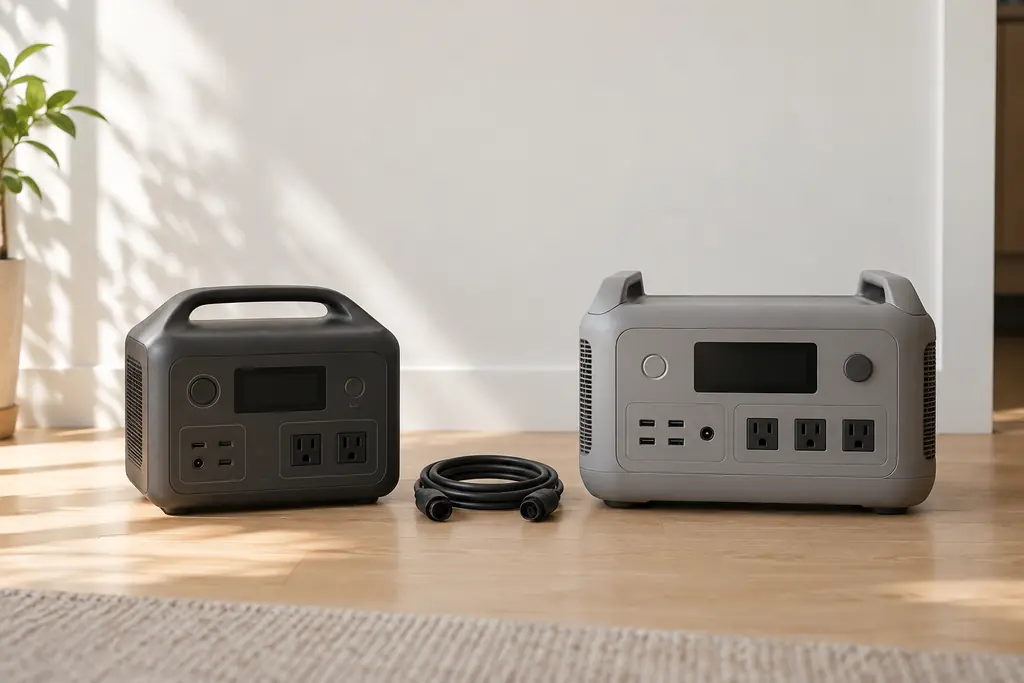
Which one to choose
The FOSSiBOT F2400 and Anker SOLIX C2000 Gen 2 start with the same rated battery capacity, battery chemistry and continuous AC output. Both are 120 V stations. Compare expansion, charging, outlets and UPS limits rather than base-unit runtime.
Choose the FOSSiBOT F2400 if
Consider the FOSSiBOT F2400 if you want a fixed-capacity station and can accept slower wall charging. FOSSiBOT states that the F2400 does not support battery expansion. It has 6 AC outlets, a 500 W solar input limit and a listed 4,800 W surge rating.
The UPS distinction also matters. The F2400 manual says a transfer takes about 8 ms, while the product page says 10 ms. On US units, the manual limits AC output to under 1,100 W in UPS mode. Compare that limit with the equipment you intend to leave connected.
Choose the Anker SOLIX C2000 Gen 2 if
Choose the Anker SOLIX C2000 Gen 2 if expansion or faster charging is important. Anker lists a 4,096 Wh expanded capacity with its BP2000 Expansion Battery (Gen 2). It also lists 1,800 W AC charging, 800 W solar input and a 10 ms UPS transfer time.
Its 6 AC outlets include a TT-30R rated at 120 V and 20 A maximum. Anker lists a weight of 41.7 lb, compared with FOSSiBOT's 48.5 lb.
| Decision point | FOSSiBOT F2400 | Anker SOLIX C2000 Gen 2 |
|---|---|---|
| Battery and continuous AC | 2,048 Wh LFP, 2,400 W at 120 V | 2,048 Wh LFP, 2,400 W at 120 V |
| Capacity expansion | Not supported, per FOSSiBOT FAQ | Up to 4,096 Wh with BP2000 Expansion Battery (Gen 2) |
| Wall charging | 1,100 W maximum, about 2 hours to full | 1,800 W maximum, 88 minutes to full |
| Solar input | 500 W, 11.5 to 50 V | 800 W, 11 to 60 V |
| Peak and boost | 4,800 W surge listed; voltage reduction above 2,400 W | 4,000 W peak listed; SurgePad up to 3,000 W |
| UPS transfer | About 8 ms in manual, 10 ms on page; US UPS under 1,100 W | 10 ms |
| AC outlets | 6, no TT-30R or L14-30R | 6 including TT-30R, rated 120 V and 20 A |
| Weight and warranty | 48.5 lb; policy states 2 years, page advertises 5 years (2+3) | 41.7 lb; US policy states 5 years |
Quick verdict
| If you need | Pick |
|---|---|
| Expansion from 2,048 Wh to 4,096 Wh using an extra battery | Anker SOLIX C2000 Gen 2 |
| A full wall charge in 88 minutes at 1,800 W | Anker SOLIX C2000 Gen 2 |
| A 120 V TT-30R outlet with a 20 A maximum | Anker SOLIX C2000 Gen 2 |
| A listed 4,800 W surge rating, with voltage-reduction limits | FOSSiBOT F2400 |
| Car charging at 200 W from a 24 V vehicle socket, against Anker's 100 W | FOSSiBOT F2400 |
Runtime in an outage
Both base units have 2,048 Wh of rated capacity, so our calculated runtimes match. Our calculation assumes 80% to 90% of rated battery capacity reaches AC appliances. Actual use and start-up demand matter.
For the FOSSiBOT F2400:
- Refrigerator averaging 60 W: 27.3 to 30.7 hours.
- Refrigerator plus chest freezer averaging 84 W together: 19.5 to 21.9 hours.
- Wi-Fi router plus modem at 16.4 W: 99.9 to 112.4 hours.
- Gas furnace blower at 282 W while running: 5.8 to 6.5 hours.
- CPAP with heated humidifier at 56.1 W, using 8-hour nights: 3.7 to 4.1 nights. Confirm with the device maker and your doctor before relying on a power station.
For the Anker SOLIX C2000 Gen 2:
- Refrigerator averaging 60 W: 27.3 to 30.7 hours.
- Refrigerator plus chest freezer averaging 84 W together: 19.5 to 21.9 hours.
- Wi-Fi router plus modem at 16.4 W: 99.9 to 112.4 hours.
- Gas furnace blower at 282 W while running: 5.8 to 6.5 hours.
- CPAP with heated humidifier at 56.1 W, using 8-hour nights: 3.7 to 4.1 nights. Confirm with the device maker and your doctor before relying on a power station.
With Anker's stated 4,096 Wh expanded configuration, our calculation rises to 54.6 to 61.4 hours for the refrigerator averaging 60 W and 39.0 to 43.9 hours for the refrigerator and freezer averaging 84 W together. Those expanded figures require the compatible extra battery. FOSSiBOT states no expansion option for the F2400.
Use the runtime calculator to compare your own loads. A continuous output rating alone does not establish whether a refrigerator compressor or furnace motor will start. Check the appliance's start-up demand separately.
Charging and solar
FOSSiBOT lists 1,100 W maximum AC input and a charging knob adjustable from 300 W to 1,100 W. Its manual says a full charge takes about 2 hours on 1,100 W AC. The product page's faster 1.5-hour claim requires 500 W of added solar, prime sunshine and ideal panel orientation; it is not a wall-only charging time. FOSSiBOT lists 1,600 W as the maximum combined AC and solar input.
For panels, the F2400 manual specifies a single Anderson MPPT input, 11.5 to 50 V, 20 A and 500 W maximum. An Anderson-to-MC4 cable is included.
Anker lists a full charge in 88 minutes using 1,800 W AC input. It separately claims 58 minutes with a combined 2,600 W of AC and solar input. Its solar input is rated to 800 W over 11 to 60 V through XT-60. The input specification lists 8.2 A at 11 to 28 V and 17 A at 28 to 60 V.
Car input is another distinction. FOSSiBOT states 100 W from a 12 V vehicle socket or 200 W from 24 V. Anker lists 100 W car input and sells its car cable separately. Anker's separate Alternator Charger is listed at 800 W; do not confuse that accessory's figure with the station's standard car input.
Output, surge and voltage
Both stations provide 2,400 W total continuous AC output at 120 V, with 6 AC outlets. The calculator identifies a 1/2 HP sump pump at 115 V and a 1,500 W space heater as running within either station's rating. That calculator fit does not guarantee any given motor will start. Check the sump pump manufacturer's start-up requirement.
A 1 HP well pump requiring 240 V is a different case. The calculator marks both stations "Needs 240 V." Neither station's stated 120 V AC output supplies that voltage. Do not use a high surge number as a substitute for the correct voltage.
FOSSiBOT's product page lists a 4,800 W surge rating, while its FAQ describes reducing voltage above 2,400 W and shutting down above 4,600 W total or below 78 V. The manual gives no surge figure. Those statements do not describe a guaranteed 4,800 W motor-start capability. Anker lists 4,000 W peak power and a separate SurgePad mode up to 3,000 W; the manual says SurgePad is unavailable in bypass mode. Peak output and load-management modes are not the same as continuous full-voltage output.
FOSSiBOT's 6 AC receptacles do not include TT-30R or L14-30R. Its outlet described as "12V/25A (RV Outlet)" is a DC XT60 connection, not an AC RV socket. Anker has 5 standard AC outlets and a TT-30R, but Anker rates that TT-30R at 120 V and 20 A maximum.
For UPS use, read the mode restrictions rather than only the transfer-time number. FOSSiBOT's manual gives about 8 ms but limits UPS output on US units to under 1,100 W; its product page gives 10 ms. Anker lists 10 ms. Neither transfer figure by itself confirms that a sensitive device will tolerate the interruption.
What to check in a listing
Verify the full model name and what is included. An Anker listing should clarify whether it includes the BP2000 Expansion Battery (Gen 2), which is required to reach 4,096 Wh.
Check accessories before relying on charging claims. FOSSiBOT's 1.5-hour figure requires 500 W solar in favorable conditions. Anker's 58-minute figure combines AC and solar; its Alternator Charger and car cable are sold separately. The F2400 includes an Anderson-to-MC4 cable.
Finally, compare the warranty wording, not just the headline. FOSSiBOT's manual and warranty policy say 24 months, while the product page promotes 5 years (2+3). Ask the seller what steps, if any, secure the advertised additional coverage. FOSSiBOT's technical specifications state 3,500+ cycles to 80% capacity, while its headline claims 4,000+; its manual says more than 3,500 cycles without an end-capacity figure. Anker lists 4,000 cycles to 80% and a 5-year US warranty. Keep those source differences in mind when comparing listings.
Questions readers ask
Can the F2400 or C2000 Gen 2 use an extra battery?
FOSSiBOT states that the F2400 is a single unit and does not support battery expansion. Anker lists expansion from 2,048 Wh to 4,096 Wh when paired with the compatible Anker SOLIX BP2000 Expansion Battery (Gen 2). Check that the battery is included in a listing before assuming the larger capacity.
Which has faster wall charging?
Anker lists 88 minutes to full on 1,800 W AC, compared with FOSSiBOT's about 2 hours at 1,100 W AC. FOSSiBOT's claimed 1.5-hour charge uses 500 W of solar alongside wall input in prime sunshine with ideal panel orientation. Anker's 58-minute claim also uses combined AC and solar input, not wall charging alone.
Can these stations run a sump pump or a well pump?
For a 1/2 HP sump pump at 115 V, the site calculator marks both stations as running within their ratings. A 1 HP well pump at 240 V is marked as needing 240 V for both because these are 120 V stations. Check the pump maker's start-up requirements; continuous wattage or a listed peak figure cannot confirm motor starting.
How long can they run a CPAP with a heated humidifier?
For a CPAP drawing 56.1 W with a heated humidifier over 8-hour nights, our calculation estimates 3.7 to 4.1 nights for either base station. The estimate assumes 80% to 90% of rated battery capacity reaches AC appliances. Confirm with the device maker and your doctor before relying on a power station.