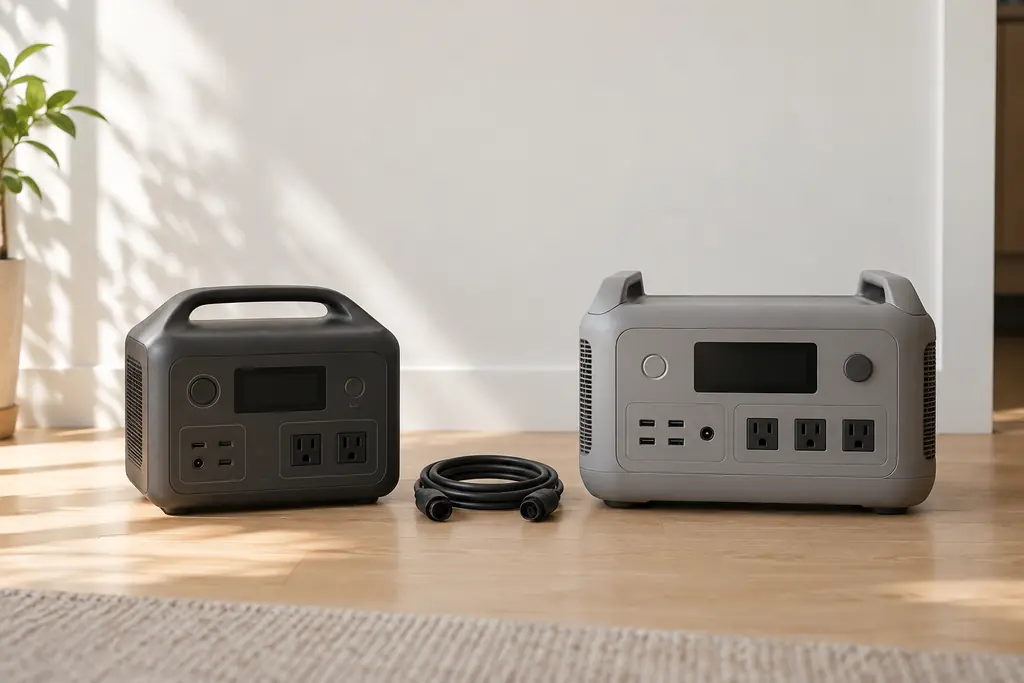
Which one to choose
Choose the DELTA 3 Plus if
Start with the DELTA 3 Plus if you plan to connect expansion batteries or take in more solar power. EcoFlow lists up to 1,000 W of solar input through two XT60 connections and describes expansion to about 5 kWh. It has six AC outlets, while both models share 1,024 Wh of built-in capacity and 1,800 W of continuous AC output. Expansion calls for compatible extra batteries and an Alternator Charger XT150 output cable, so check which parts a listing includes.
Choose the DELTA 3 Classic if
Start with the DELTA 3 Classic if 500 W of solar input meets your plan and you want the 2,600 W X-Boost figure that both of its documents agree on. EcoFlow states 0 to 80% in 45 minutes and a full charge in 60 minutes from the wall, against 56 minutes for a full charge on the Plus. The Classic weighs 26.6 lb against 27.6 lb and has a 10 ms standby UPS switchover. EcoFlow does not state whether the Classic supports expansion, so plan around its stated 1,024 Wh capacity.
Quick verdict
| If you need | Pick |
|---|---|
| Expansion to about 5 kWh (EcoFlow does not state expansion capability for the Classic) | EcoFlow DELTA 3 Plus |
| Up to 1,000 W of solar input, against 500 W | EcoFlow DELTA 3 Plus |
| Six AC outlets (EcoFlow does not state the Classic's outlet count) | EcoFlow DELTA 3 Plus |
| The shortest stated full wall charge: 56 minutes against 60 minutes | EcoFlow DELTA 3 Plus |
| A solar plan within 500 W and the 2,600 W X-Boost figure that both of EcoFlow's documents give for the Classic (the Plus lists 2,200 W on the spec page and 2,600 W in the manual) | EcoFlow DELTA 3 Classic |
| No plan for expansion or more than 500 W of solar, and a slightly lighter unit: 26.6 lb against 27.6 lb | EcoFlow DELTA 3 Classic |
What differs between the two
The shared battery capacity hides differences in charging, solar input and extra equipment.
| Decision point | DELTA 3 Plus | DELTA 3 Classic |
|---|---|---|
| Solar input | Up to 1,000 W, two XT60 inputs at 500 W each | 500 W, one XT60 input |
| Expansion | About 5 kWh stated, with compatible extra batteries and an Alternator Charger XT150 output cable | EcoFlow does not state expansion capability |
| Wall charging | 1,500 W, 0 to 100% in 56 minutes | 1,400 W, 0 to 80% in 45 minutes, full in 60 minutes |
| X-Boost | 2,200 W on the US spec page; 2,600 W at 120 V in the US manual | 2,600 W in both sources |
| AC outlets | 6 | EcoFlow does not state the number |
| UPS switchover | Under 10 ms | 10 ms standby UPS |
| Warranty | 5 years | 3 years plus 2 after EcoFlow app registration |
Both units have 1,024 Wh LFP batteries, 1,800 W of continuous AC output at 120 V and a 3,600 W surge rating. Neither supplies 240 V, which matters if your well pump requires that voltage. The Plus weighs 27.6 lb. The Classic weighs 26.6 lb according to its manual, while EcoFlow's US spec page lists 12.1 kg + 0.3 kg without a pound figure. EcoFlow states 4,000 cycles to 80%+ capacity for the Plus; it does not state a cycle count for the Classic, although its page claims about a 10-year lifespan.
Runtime in an outage
Because the two stations have the same 1,024 Wh rated capacity, our calculated runtimes are identical at these appliance loads.
- Refrigerator averaging 60 W: 13.7 to 15.4 hours.
- Refrigerator plus chest freezer at 84 W combined: 9.8 to 11.0 hours.
- Wi-Fi router and modem at 16.4 W: 50.0 to 56.2 hours.
- Gas furnace blower at 282 W: 2.9 to 3.3 hours of blower run time.
- CPAP with heated humidifier at 56.1 W for 8-hour nights: 1.8 to 2.1 nights.
These runtimes are our calculation, assuming 80% to 90% of rated capacity reaches AC appliances. The refrigerator number uses a 60 W average, while the furnace number counts only the time the blower runs. Check the loads for your own appliances against our refrigerator, freezer and CPAP guides. For a different combination of loads, use the runtime calculator.
Expanding the Plus changes the energy available for these examples. At EcoFlow's rounded "about 5 kWh" expanded capacity, our calculation gives 66.7 to 75.0 hours for the 60 W refrigerator and 47.6 to 53.6 hours for the 84 W refrigerator plus chest freezer. Those figures apply to the expanded setup rather than the built-in 1,024 Wh battery, and EcoFlow gives the expanded capacity as an approximate figure without an exact Wh total.
Solar and car charging
The Plus accepts up to 1,000 W from solar through two XT60 inputs, each limited to 500 W. The Classic accepts up to 500 W through one XT60 input. Both specify an 11 to 60 V solar range and a 15 A limit per input, so a panel array that suits one Classic input also has to stay inside those limits on each Plus input.
Both units list a 12 V, 8 A car input through XT60. EcoFlow gives the Classic a 96 W maximum but does not state a watt figure for the Plus car input. The advertised "800 W car charging" for the Plus refers to a separately sold 800 W Alternator Charger, so keep that accessory apart from the built-in XT60 car input when you read a listing.
Expansion also changes the equipment list. EcoFlow names the DELTA 3, DELTA 2, DELTA 2 Max and DELTA Pro 3 Extra Batteries as compatible with the Plus, connected through an Alternator Charger XT150 output cable. It describes expansion as "1-5kWh expandable" but gives no exact Wh figure for the expanded total. For the Classic, EcoFlow does not state expansion capability on either the US spec page or the manual.
The X-Boost figure EcoFlow states two ways
EcoFlow gives two X-Boost figures for the Plus in its US documents. The spec table lists 2,200 W, and the US manual's table gives 2,600 W at 120 V. We use 2,200 W for the Plus and flag the manual figure rather than treating the documents as consistent. The Classic has a stated 2,600 W X-Boost figure in both its spec page and manual.
The two models still have the same stated continuous AC output of 1,800 W and surge rating of 3,600 W. Those ratings are separate from X-Boost, so keep the figures apart when you compare them with an appliance's requirements. EcoFlow also specifies only 120 V AC output for both models, so a load that needs 240 V is outside what either station states.
Telling them apart in a listing
Read the full DELTA 3 Plus or DELTA 3 Classic model name rather than relying on "DELTA 3." Two XT60 solar inputs, a stated 1,000 W solar maximum and expansion to about 5 kWh match the Plus. One XT60 solar input and a 500 W maximum match the Classic. Both were current on EcoFlow's US store when checked on October 9, 2026, and EcoFlow does not state how the two models relate.
Check whether a Plus listing includes any extra battery or the Alternator Charger XT150 output cable needed for expansion. The built-in battery is 1,024 Wh, and the about 5 kWh figure refers to the expanded setup. Also confirm the warranty steps: the Plus has a stated five-year warranty, while the Classic adds two years to its three-year standard coverage after registration in the EcoFlow app. The Black Friday 2026 checklist also covers model-name checks, separate parts and registration.
Questions readers ask
Is the EcoFlow DELTA 3 Classic expandable?
EcoFlow does not state expansion capability for the DELTA 3 Classic on its US spec page or in its manual. It also does not state that the model is not expandable.
Which charges faster from the wall?
The DELTA 3 Plus charges from 0 to 100% in 56 minutes at 1,500 W. The DELTA 3 Classic takes 60 minutes for a full charge at 1,400 W, with 0 to 80% stated at 45 minutes.
Which takes more solar input?
The DELTA 3 Plus accepts up to 1,000 W through two XT60 inputs rated at 500 W each. The DELTA 3 Classic accepts up to 500 W through one XT60 input.
Which has the higher X-Boost figure?
The DELTA 3 Classic states 2,600 W in both its US manual and spec page. For the DELTA 3 Plus, the US spec page says 2,200 W while the manual says 2,600 W at 120 V; we use 2,200 W.