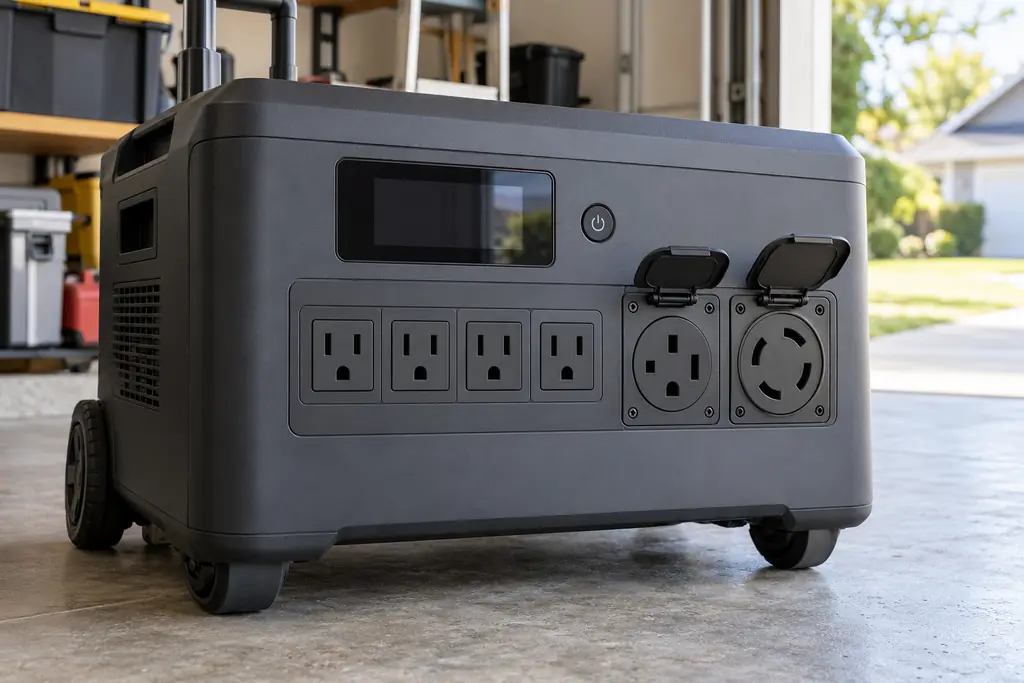
Which one to choose
The FOSSiBOT F7200, EcoFlow DELTA Pro Ultra and Jackery Explorer 5000 Plus all target larger outage loads with 120 V and 240 V output.
Each lists 7,200 W continuous AC output, but FOSSiBOT's manual states that rating for 220-240 V units. Its US outlet information comes from a separate table and product images. Do not assume every rating in that manual applies unchanged to the US model.
Choose the FOSSiBOT F7200 if
Consider the F7200 if its 5,222.4 Wh base battery, stated 9,000 W surge rating and separate solar inputs suit your loads. FOSSiBOT lists 6,500 cycles to 80% capacity and expansion to 15,666 Wh with two FB5222 batteries.
The documentation needs careful reading. The manual describes 220-240 V equipment, while US images show 120 V and 240 V receptacles. The US outlets are labelled 20 A at 120 V and 30 A at 240 V. FOSSiBOT does not state whether the 240 V output is split-phase.
Choose the EcoFlow DELTA Pro Ultra if
Choose the DELTA Pro Ultra if you want the largest base capacity here, 6,144 Wh, or its stated expansion to about 30,000 Wh with five batteries per inverter.
EcoFlow lists 5,600 W total solar input and distinguishes between online-UPS outlets with 0 ms transfer and backup-UPS outlets with under 20 ms transfer. Its inverter provides 120/240 V output, but EcoFlow says 240 V output is unavailable while charging at 240 V.
The base set consists of an inverter and a battery.
Choose the Jackery Explorer 5000 Plus if
Consider the Explorer 5000 Plus if the listed 14,400 W surge rating, 240 V receptacles and 134.5 lb weight matter more than base battery capacity.
Jackery starts at 5,040 Wh and lists expansion to 30,000 Wh with five battery packs. Its outlets include L14-30R and 14-50R, although neither can be used in Bypass mode on the AC charging cable.
Jackery lists a 20 ms UPS transfer, with a separate Online UPS mode that reaches 0 ms only on specified outlets and within a lower output limit.
| Decision point | FOSSiBOT F7200 | EcoFlow DELTA Pro Ultra | Jackery Explorer 5000 Plus |
|---|---|---|---|
| Base capacity | 5,222.4 Wh LFP | 6,144 Wh LFP | 5,040 Wh LFP |
| Continuous AC | 7,200 W, manual rating for 220-240 V units | 7,200 W, 120/240 V | 7,200 W, 120/240 V |
| Listed surge | 9,000 W | 10,800 W | 14,400 W |
| Expansion | 15,666 Wh with two FB5222 batteries | About 30,000 Wh with five batteries per inverter | 30,000 Wh with five battery packs |
| Solar input | 2,500 W high-voltage, 1,200 W low-voltage | 5,600 W combined | 4,000 W combined |
| Charging | 3,000 W needs 240 V; US 120 V label says 1,800 W | 3,000 W C20 input at 240 V | 3.5 hours on AC cable |
| UPS | 10 ms; manual limits UPS to 3,000 W on 220-240 V units | 0 ms online, under 20 ms backup | 20 ms; 0 ms in restricted Online UPS mode |
| Weight | 154.3 lb | Inverter about 70.8 lb plus battery about 111.3 lb | 134.5 lb |
Quick verdict
| If you need | Pick |
|---|---|
| The largest base battery here at 6,144 Wh | EcoFlow DELTA Pro Ultra |
| Up to 5,600 W combined solar input | EcoFlow DELTA Pro Ultra |
| A listed 14,400 W surge rating | Jackery Explorer 5000 Plus |
| L14-30R and 14-50R 240 V outlets on one 134.5 lb unit | Jackery Explorer 5000 Plus |
| A stated 6,500 cycles to 80% battery capacity | FOSSiBOT F7200 |
| Separate 2,500 W high-voltage and 1,200 W low-voltage solar inputs | FOSSiBOT F7200 |
Runtime in an outage
These are our calculations, assuming 80% to 90% of rated battery capacity reaches AC appliances. Actual runtimes vary with appliance demand and operating conditions.
For the FOSSiBOT F7200 at 5,222.4 Wh:
- Refrigerator averaging 60 W: 69.6 to 78.3 hours.
- Refrigerator plus chest freezer at 84 W together: 49.7 to 56.0 hours.
- Wi-Fi router plus modem at 16.4 W: 254.8 to 286.6 hours.
- Gas furnace blower at 282 W while running: 14.8 to 16.7 hours.
- CPAP with heated humidifier at 56.1 W, using 8-hour nights: 9.3 to 10.5 nights. Confirm with the device maker and your doctor before relying on a power station.
For the EcoFlow DELTA Pro Ultra at 6,144 Wh:
- Refrigerator averaging 60 W: 81.9 to 92.2 hours.
- Refrigerator plus chest freezer at 84 W together: 58.5 to 65.8 hours.
- Wi-Fi router plus modem at 16.4 W: 299.7 to 337.2 hours.
- Gas furnace blower at 282 W while running: 17.4 to 19.6 hours.
- CPAP with heated humidifier at 56.1 W, using 8-hour nights: 11.0 to 12.3 nights. Confirm with the device maker and your doctor before relying on a power station.
For the Jackery Explorer 5000 Plus at 5,040 Wh:
- Refrigerator averaging 60 W: 67.2 to 75.6 hours.
- Refrigerator plus chest freezer at 84 W together: 48.0 to 54.0 hours.
- Wi-Fi router plus modem at 16.4 W: 245.9 to 276.6 hours.
- Gas furnace blower at 282 W while running: 14.3 to 16.1 hours.
- CPAP with heated humidifier at 56.1 W, using 8-hour nights: 9.0 to 10.1 nights. Confirm with the device maker and your doctor before relying on a power station.
Expansion changes the calculation:
- FOSSiBOT at its stated 15,666 Wh: refrigerator 208.9 to 235.0 hours; refrigerator plus freezer 149.2 to 167.8 hours.
- EcoFlow at its stated approximately 30,000 Wh: refrigerator 400.0 to 450.0 hours; refrigerator plus freezer 285.7 to 321.4 hours.
- Jackery at its stated 30,000 Wh: refrigerator 400.0 to 450.0 hours; refrigerator plus freezer 285.7 to 321.4 hours.
These expanded configurations require additional batteries. Use the runtime calculator for other appliance loads.
Charging and solar
FOSSiBOT lists 3,000 W AC charging, but that requires a 240 V supply. Its US label gives 1,800 W at 120 V. FOSSiBOT also limits AC charging to 2,000 W above 85% battery.
The manual states 2.5 hours to full at 3,000 W, while the product page claims approximately 2 hours 15 minutes. No full-charge time is stated for the 120 V input. FOSSiBOT's 1.5-hour claim requires AC plus both solar inputs.
Its high-voltage solar input accepts 120 to 450 V and up to 2,500 W through MC4. A separate XT90 input accepts 12 to 50 V, 30 A and 1,200 W. The product page gives 12 to 55 V for that lower-voltage range. FOSSiBOT does not state a combined solar-only maximum.
EcoFlow lists 3,000 W through its C20 wall input at 240 V. It also advertises a 6,200 W fastest input with one battery and approximately 92 minutes from empty to full, but does not identify the charging source for that figure. Do not treat it as a standard wall-charge time.
EcoFlow's solar maximum is 5,600 W, split between 4,000 W high-voltage input at 80 to 450 V and 1,600 W low-voltage input at 30 to 150 V. Both have a 15 A limit.
Jackery lists 3.5 hours on its AC cable, with input specified as 120 V, 15 A maximum. It claims 1.7 hours through a Smart Transfer Switch, sold separately.
Jackery's solar maximum is 4,000 W across high- and low-voltage inputs. The low-voltage side accepts 11 to 60 V and up to 1,200 W; high-voltage input accepts 135 to 450 V. Jackery claims approximately 2 hours with up to 4,000 W solar input.
Vehicle charging differs too. FOSSiBOT lists 200 W at 12 V or 24 V. EcoFlow does not state a car input rating. Jackery's manual describes 12 V car charging, but its specification page says the 12 V car adapter is not supported.
Output, surge and voltage
All three list 120 V and 240 V output, but outlet limits matter. FOSSiBOT's US panel images label 120 V outlets at 20 A and 240 V outlets at 30 A. Its manual's 7,200 W rating is for 220-240 V equipment, with protection for each output group above 20 A.
EcoFlow has 6 AC outlets, including TT-30R and L14-30R. Jackery also has 6, including L14-30R and 14-50R.
For a 1 HP well pump, the calculator gives these exact fits:
- FOSSiBOT F7200: Well pump, 1 HP submersible (240 V, 4-inch): Start-up may exceed surge rating; runtime 2.5 h to 4 h
- EcoFlow DELTA Pro Ultra: Well pump, 1 HP submersible (240 V, 4-inch): Start-up may exceed surge rating; runtime 3 h to 5 h
- Jackery Explorer 5000 Plus: Well pump, 1 HP submersible (240 V, 4-inch): Runs within the rating; runtime 2.5 h to 4 h
Check the pump's starting requirements with its manufacturer. A continuous rating or listed surge figure does not guarantee a particular motor will start.
Supplying household circuits needs listed transfer equipment, either a transfer switch or an interlock kit with an inlet, installed by a licensed electrician with any required permit. See the transfer switch guide for the safety requirements.
The UPS figures also require attention. FOSSiBOT's 10 ms claim comes with a 3,000 W limit in the manual for 220-240 V units. EcoFlow's 0 ms applies only to online-UPS outlets; backup-UPS outlets, including the 240 V outlet, are under 20 ms.
Jackery lists 20 ms normally. Its 0 ms Online UPS mode works only on the four 20 A outlets up to 3,600 W. Jackery does not recommend the station for medical devices or life support.
What to check in a listing
Confirm the model, regional outlet configuration and included batteries. FOSSiBOT expansion requires two separately sold FB5222 batteries; the product page rounds the maximum to 15,667.2 Wh, while the stated expansion figure is 15,666 Wh. The FB5222 was not listed in FOSSiBOT's own store on November 2, 2026.
EcoFlow's base set includes an inverter and battery. Its stated expansion requires additional DELTA Pro Ultra batteries. Jackery uses Battery Pack 5000 Plus units, model JBP-5000A.
Check charging accessories and the electrical supply required for advertised charging times. In particular, do not compare FOSSiBOT's 240 V charging time, EcoFlow's unspecified-source fastest-input claim and Jackery's separately equipped Smart Transfer Switch charging as though they were identical wall-charging conditions.
Finally, read the warranty conditions. FOSSiBOT's manual and policy state 2 years, while the product page advertises 5 years (2+3). EcoFlow lists 5 years for both inverter and battery without a registration condition. Jackery lists 5 years standard, with another 2 years available for a fee; its specification page says the 5-year warranty applies exclusively to jackery.com purchases.
These details can matter as much as the headline capacity when choosing a station for outage backup.
Questions readers ask
Can these power stations supply 240 V household circuits?
All three list 240 V outlets, but their output and charging restrictions differ. Supplying household circuits needs listed transfer equipment, either a transfer switch or an interlock kit with an inlet, installed by a licensed electrician with any required permit. Read the transfer switch guide before planning household backup.
Which station can start a 1 HP well pump?
For a 1 HP submersible well pump at 240 V, the site calculator marks Jackery as running within its rating, with 2.5 h to 4 h of runtime. FOSSiBOT and EcoFlow are marked as having start-up demand that may exceed their surge ratings. None of these estimates guarantees motor starting. Check the pump's starting requirements with its manufacturer.
Which charges fastest from a wall outlet?
The charging conditions are not directly comparable. FOSSiBOT states 2.5 hours at 3,000 W, requiring 240 V, while its US label lists 1,800 W at 120 V without a full-charge time. Jackery lists 3.5 hours using its AC cable. EcoFlow lists 3,000 W through its C20 wall input at 240 V, but does not state a full-charge time for that input.
Which has the shortest UPS transfer time?
EcoFlow lists 0 ms on its online-UPS outlets and under 20 ms on backup-UPS outlets, including its 240 V outlet. Jackery lists 20 ms normally, or 0 ms in Online UPS mode on its four 20 A outlets up to 3,600 W. FOSSiBOT lists 10 ms, with a 3,000 W UPS limit stated in the manual for 220-240 V units. Check outlet and equipment requirements.